by Connie Sieh Groop
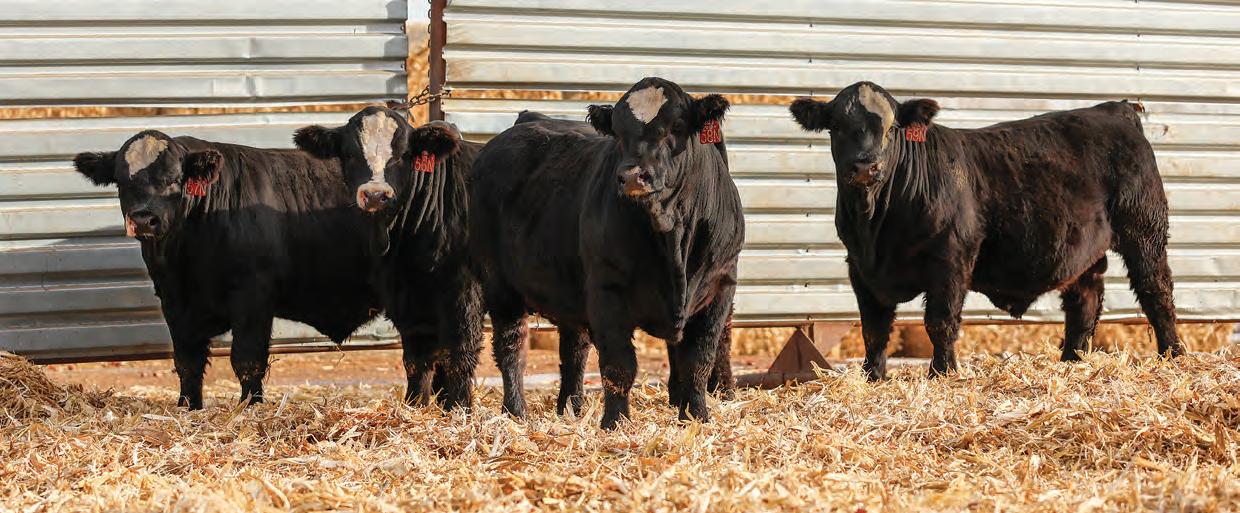
In February of last year, Stavick Simmental near Veblen, South Dakota, welcomed the birth of quadruplet calves
— a rare event that Mike Stavick describes as extremely lucky. Remarkably, these calves thrived and made history again this year when they were sold through the ranch’s sale ring.
Editor’s note: This article is reprinted with permission from Cattle Business Weekly. Photographs by Liv Stavick.
he odds of a cow giving birth to four healthy bull calves are extraordinarily low, estimated by some to be just one in 179.2 million. Having those calves mature into breeding animals makes the occurrence even more unusual.
“I don’t know that there has ever been a set of quad bulls sold at a sale in the United States — ever,” Stavick says. “It’s a pretty unique deal. They are good-looking animals. It’s unheard-of to have quad calves, all males, develop enough to be offered at sale. Since we raise breeding bulls, it’s really tough for bulls to be good enough to make the sale. They have to be the top of the top, right? So every calf that’s not of quality becomes a steer and goes into the food supply.”
Bill and Holly Johnson and their son, Caleb, of Hosmer, South Dakota, purchased the four bulls at Stavick’s King of the Range Production Sale on February 5. The young bulls sold in the top third group at Stavick’s sale, and there were a number of buyers looking at the quads.
To have these four calves make the grade for breeding is pretty phenomenal. DNA genomics confirmed that every calf carries the exact same genetic profile. They are not technically clones, but all four are homozygous black, all four are homozygous polled, and all four are genetically identical.
“So, they are literally clones that we got out of one cow without having to do any cloning costs, which are astronomical,” Stavick says. “I honestly thought maybe one or two might make the sale. Even when twins are born sometimes one will have a tough time as they compete for milk. They always just don’t seem to be as good as a big single. But to have all four make it is pretty amazing.”
Trying to get documentation of the calves proved to be tricky. “We ran into problems with DNA testing because they are exact duplicates of each other. They’re not siblings like brother and sister. They are exact duplicates.”
“What they are telling me is that the embryo fragmented,” Stavick says. “The four parts attached to the uterus and developed. When we sent the DNA tests in to register the calves, we were told there’s a problem with two of the calves because they’re exactly the same as the other two. So they kicked them back and said that they didn’t qualify. It took some phone calls and cost quite a bit more money to have everything sent back through again. And then it came back as exact duplicates.”
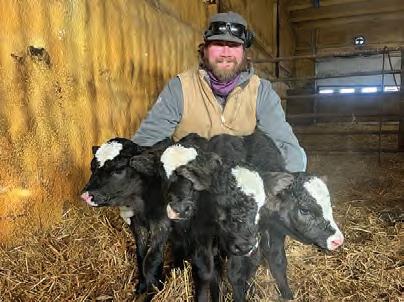
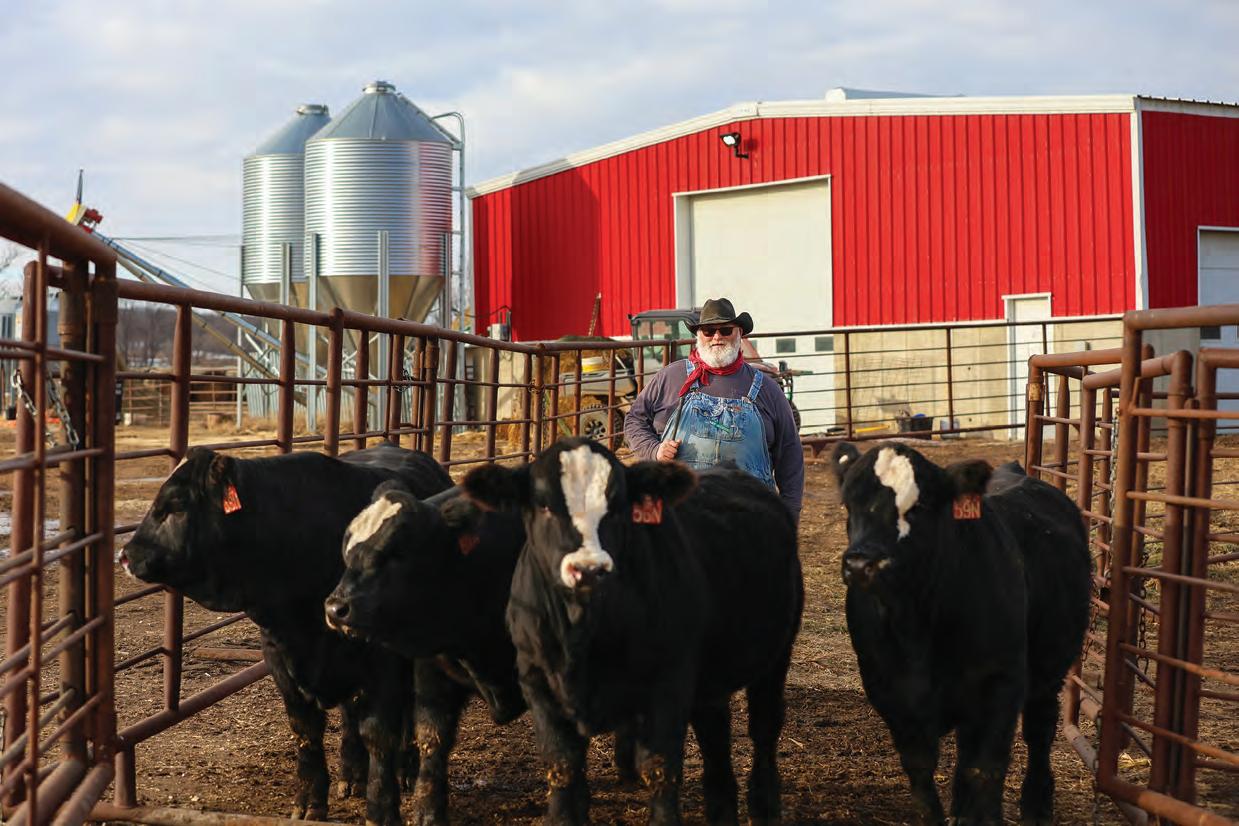
Above: Owen Stavick with the “quads” shortly after birth. Opposite: Mike Stavick was surprised, and proud, when all four of the quadruplet bull calves started developing into top herd bull prospects.
He says they ran into the same thing with getting the calves registered with the American Simmental Association. The group had never registered a set of quads before; their herdbook data is set up for twins and even triplets but not quads. They had to redo some of their software. “I was pretty adamant that we were going to do whatever it took to make sure that everybody knows they are quads.”
The registered names of the calves are Curly and Moe (of The Three Stooges fame), and Harry and Lloyd (from the movie Dumb and Dumber). Stavick says he treats them like any other calf but his kids could likely pick them out of the herd.
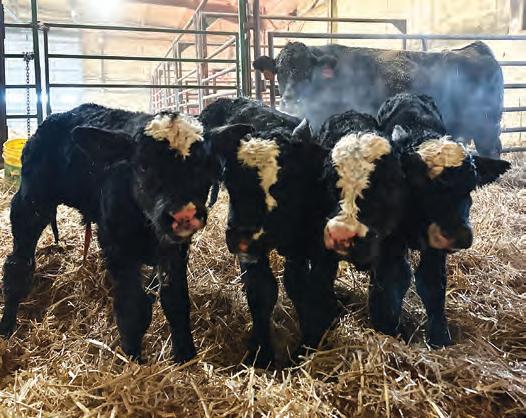
The mother of the quadruplets, Barb 458D, didn’t miss a beat after giving birth, breeding back for 2026.
The calves ran with the herd through the last year with no special treatment. The animals were raised by separate cows in separate pastures, yet when they all came back together as a herd, the four all looked and weighed pretty much the same. “It’s pretty remarkable, really,” Stavick says. Their weaning weights were around 650 and on sale day, they were all around 1,300 pounds.
“When you buy a bull, he’s probably going to breed 25–30 cows a year. With these four bulls and you turn them out with a hundred cows, it’s like you are AI-ing to one bull.”
“I like that the Johnsons bought the calves, as that means we can watch them grow and breed over the next five to six years. We can see if they have any issues. I mean, who better to sell them to than someone like Holly who is a veterinarian? She’s going to watch them pretty closely.”
This year, the Stavicks are about half-done with calving. Stavick says, “We do a pretty good job of watching our animals. There is a lot of effort put in by the whole family to watch over every cow in the herd to make sure they are comfortable. We are in the midst of calving. Normally the cows and calves stay in the maternity pen for a couple weeks. With the weather in the 50s, we’ve been able to move the pairs to the close-by pastures within a day or two.”
As of February 14, Stavick says they’ve had 13 sets of twins, which is fairly normal. No quads this year. They’ve had some days with 30 to 40 calves born. Things will slow with another 30 days of calving. “It’s so nice, we’ve hauled the pairs out. We normally have to watch them in the maternity pen for a week to ten days to make sure everything is going well with the cow because of the cold and snow. Now they’re able to go to the close-by
calving pasture where they have plenty of shelter. They are out where they can move around and not lay on top of each other.”
Barb, the mom of the quads? She had a nice big bull calf born February 13, which will likely be in the sale next year. She’s a 2016 model cow, making her ten years old. “I’m pretty amazed that she bred back so well with AI,” Stavick says. “Carrying the quads took a lot out of her but she was strong and didn’t have any issues recovering. She was never sick. I actually thought that when those calves were born, we would lose Barb since there was so much stress on her. She is pretty special. And so are her calves.”
A New Home
As the veterinarian who has watched the quad calves since they were small, Holly Roe-Johnson was thrilled that she and her family will continue to oversee their development. Holly is the owner of the Hosmer Veterinary Clinic and now owns the quad calves. “Last year, Mike Stavick called and sent me a video the morning after the calves were born,” she recalls. “The birth was rare and for them to survive and thrive is amazing. There have been a lot of hoops that the young bulls have jumped through to get to the sale ring at the ranch.”
On the way to the sale, each member of the Johnson family had made their picks. And they had marked a couple of the quads as potential purchases. “When it came down to it, we needed the bull power and got the bid,” Holly says. “We discussed it briefly and I said, ‘Hey guys, they are genetically the same. If one makes your list, then they all make the list.’ So we bought all four. I’m really glad they will all stay together. At the sale, I remarked that whoever gets the bid, they have to keep the quads together to compare how they do. This is a once-in-a-lifetime opportunity to watch them grow and see what kind of a calf crop they produce.”
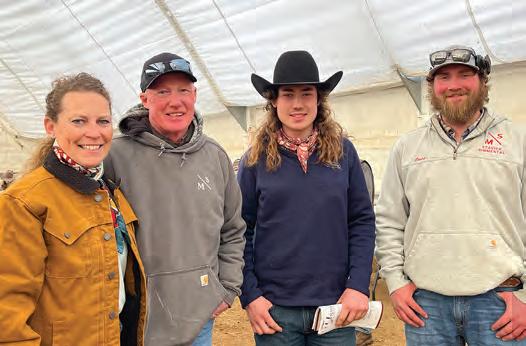
Above: Holly, Bill, and Caleb Johnson, with Owen Stavick. Below: Stavick Simmentals maintains a high standard for the bulls they offer for sale. All four bulls made the cut phenotypically and genetically.
Holly says the quads are still developing. Measurements were taken in January to make sure everything for breeding is developing correctly. At the end of March, the whole group will be semen-tested. Initially, the Johnsons plan to put the quads in different pastures on their land in Edmunds County where there will be some older bulls. Holly said it’s generally not a good idea to keep yearling bulls in the same pasture. After they are two years old, they’ll put the four of them in a pasture with 80 to 100 cows. That will give the Johnsons an opportunity to see what kind of calves will come from the matings. All the calves will be half-siblings, which means they will be able to see the genetics the bulls passed on. Holly says, “And we’ll see how the next chapter of their lives develop.” “Hopefully, these bulls will provide uniform calves in our program to sell feeder cattle. I hope they make it to five or six years old, and am anxious to see how they look as adults. It will be a lot of fun to see them develop but I also realize they are live animals and anything can happen. We’re looking forward to seeing calves produced by these young bulls.” .