How Fast is Mature Cow Size Increasing?
Paul Beck, Oklahoma State University Extension
Over the past 60 years, mature cow body weight has increased at an annual average of 7.7 pounds per year, but it has not increased at a constant rate. The following chart shows the average annual cow live weight estimated from USDA reports for monthly cow carcass weights. When we look at annual average live weight data, we see that the major structural shift in cow size began in the mid-1960s when selection for larger-framed, growthier cattle became popular. Before that, mature cow weight was relatively stable and even slightly declining. After 1965, cow size began a steady upward climb, increasing by approximately 6.5 pounds per year until 1995. However, the rate of growth in cow size has not been uniform throughout the years.
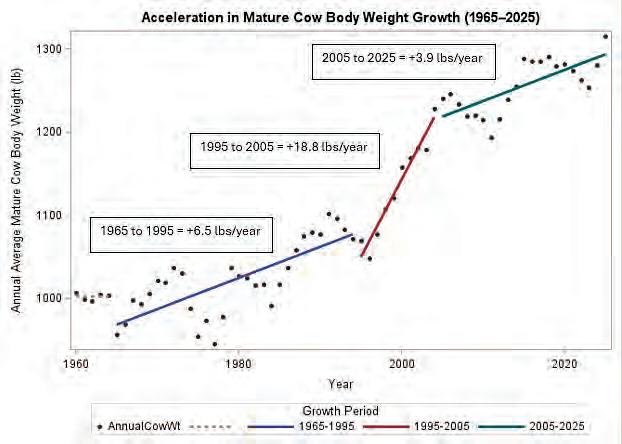
Figure 1. Average annual cow bodyweight estimated from cull cow slaughter data from 1960 to 2025.
During the 1960s and 1970s, cow size really changed very little. The increase in mature cow size began with the introduction of larger-frame Continental genetics into the US cow herd in the 1980s. This resulted in the rapid acceleration in cow weights of nearly 19 pounds per year from 1995 to 2005. During the 80s, mature cow weight increased at roughly eight pounds per year, which is 80 pounds in ten years. Along with the widespread adoption of larger-framed genetics and Continental breed influence across commercial herds, the increased emphasis on growth EPD has increased mature cow size, but is also important to modern increases in post-weaning beef production and efficiency. Selection pressure for growth, heavier weaning weights, and changing market signals all contributed to that trend.
After 2005, cow weights have shown a moderate increase of around four pounds per year, which is essentially a plateau relative to the “acceleration decade” from 1995 to 2005. The recent moderation in the increase in cow size indicates our efforts to improve maternal efficiency have been fruitful. Cow size remains substantially larger than in the 1960s. Over the six decades, that translates to over 450 additional pounds per cow.
That increase in cow size has consequences for ranch sustainability and risk tolerance. If stocking rates are not adjusted for the increased cow size, long-term rangeland productivity will suffer from overgrazing, and weather disruptions such as drought will have greater impacts.
Bigger cows require more forage, greater maintenance energy, and influence stocking rates. While larger cows can wean heavier calves, they are often not as efficient. The cow efficiency question remains critical: are we adding pounds where they generate greater returns?
Understanding how cow size has changed can help producers evaluate whether their current cow herd aligns with forage resources and profitability goals. Bigger cows are not inherently good or bad — but cows must fit the production environment or we will be required to fit the environment to the cow by providing more supplemental feed from harvested forage and concentrates.
As always, the most efficient cow is the one that matches her environment and pays her own way.
Build Smarter Deworming Plans with Diagnostics
by Wyatt Betchel
Incorporating diagnostics into deworming plans gives cattle producers a clearer handle on parasite pressure and product performance. It helps confirm when treatment is needed, when it isn’t, and when a protocol might need adjusting. For operations like Leaning Oak Ranch in Okemah, Oklahoma, that clarity has become a key advantage. And it starts with putting real numbers behind decision-making.
Turning Data into Decisions
Diagnostics provide a straightforward view of the parasite burden in your herd. A fecal egg count reduction test (FECRT) is the most reliable method for measuring deworming efficacy. “We had a group that didn’t look right, and I assumed it was a worm issue,” shares Buck Rich, owner of Leaning Oak Ranch. “But the fecal tests came back clean, and confirmed our Longrange [eprinomectin] was working the way it should. Running diagnostics saved us from reworking the cows unnecessarily.”
The results also highlighted the economic value of testing. “From an economic standpoint, that would have been wasted money on more dewormer, and wouldn’t have helped our problem,” Rich continues. “Diagnostics are an important tool, and can definitely help get you on the right path more quickly.”
Rich works closely with his herd veterinarian, Tyler Thomas, DVM, owner and operator of Prague Veterinary Clinic in Prague, Oklahoma. “It’s very easy to check fecals, and it’s a valuable tool,” Thomas says. “The data lets us know where a deworming program sits, and if we need to take action or not.”
How to Implement Diagnostics
Routine FECRTs establish a baseline on product performance, and track resistance over time. Even a few well-placed tests each year can support better decisions. Testing before spring turnout, during grazing, or at weaning are all good options. “Without diagnostics, it’s easy to point the finger at the product,” explains Jody Wade, DVM, Boehringer Ingelheim. “But if you’re not testing, you might be treating the wrong issue or not seeing the whole picture.”
To conduct the test, two manure samples are needed from the same animal: one collected before or at the time of treatment, and another collected after a specified period following treatment. The timing of the second sample depends on the product used, as each medication requires a different interval after treatment to assess its effect.
When running diagnostics, Wade emphasizes the importance of working with trusted laboratories. “Samples should be collected per rectum, stored properly and processed by reliable labs,” he adds. “Your veterinarian can help ensure everything is handled correctly, so the results are meaningful.”
An egg reduction of 95% or more indicates the dewormer performed well. When results fall short, it may signal that parasites are surviving treatment. In these situations, a herd veterinarian may recommend adjusting the timing, incorporating combination treatment, modifying the grazing rotation, or reevaluating which cattle receive treatment. The goal is always a plan rooted in evidence — not assumption.
Diagnostics in a Sustainable Deworming Plan
A sustainable deworming plan includes diagnostics and three other proven parasite management tools: combination treatment, pasture management, and refugia. “We want our deworming practices to be sustainable, and the four pillars are about helping producers get the most from the tools we already have,” Wade says. “Diagnostics are where it all begins.”
For Thomas, diagnostic results shape how he builds treatment plans for Leaning Oak Ranch and other operations. “You don’t know where to go until you know where you’re at,” he asserted. “Diagnostics tell us if treatment is even necessary, and whether what we’ve done is working.”
Three Strategies to Improve Profitability for Small Cow-calf Operations
by Dr. Kenny Burdine, University of Kentucky Extension
Running a small cow-calf operation can be rewarding, but it is not without challenges. Larger farms spread their costs over more cows, making it harder for smaller herds to compete. There also tend to be scale efficiencies related to labor, input purchases, and other expenses that make larger operations more economically efficient. But smaller producers can be profitable, and this article focuses on three strategies small operations should consider to improve their profitability.
Keep Overhead Costs in Check
Cow-calf operations are capital-intensive by nature, so I chose to use the words “in check” rather than something more specific. But the reality is that an operation running 30–40 cows can’t have the same overhead structure as one running several hundred. This sounds obvious, but I often see new cow-calf operations that are badly overcapitalized from the start. Smaller operations should focus on being lean with respect to equipment, facilities, and other fixed costs. In a lot of cases, this means limiting capital investment and ensuring that the scale of equipment is proportional to the scale of the operation. However, performing custom work with owned equipment is another way to spread that capital investment over more hours of use and add a second income stream. Regardless of what approach is taken, small cowcalf operations must be aware that disproportionately large overhead cost structures can be a major drain on profitability.
Outsource Strategically to Save Time and Money
A small cow-calf operation does not have to do everything itself, and may be best served by outsourcing some farm operations. The first area that comes to mind is hay production. It may be more economical for a small cow-calf operation to purchase hay, rather than own hay equipment and devote land and time resources to producing it themselves. In some areas, hay is not easy to source and may require significant effort. But by spending time developing relationships with hay producers and planning for winter feeding needs well in advance, the operation may be able to avoid significant hay production expenses.
Outsourcing other farm operations may also be worth consideration. For example, it may be easier to hire someone to transport cattle to market, rather than owning and maintaining hauling equipment that isn’t used very often. Heifer development is another area that can be a bit more challenging for small operations. It may make sense for a small operation to purchase a few bred heifers each year and focus on terminal production, rather than developing a small number of heifers on their own.
Outsourcing is typically justified on the basis of limiting investment (i.e., avoiding overcapitalization) or limiting variable expenses. But it also frees up another very valuable resource: time. Most small cow-calf operators have off-farm employment or other significant off-farm commitments. By outsourcing some farm operations, additional time becomes available and can be devoted to the elements of the operation the farmer chooses to focus on.
Explore Value-added Marketing Opportunities
While the first two considerations were largely focused on cost control, this one is focused on the revenue side of the profit equation. Since production costs tend to be higher for smaller operations, it is even more imperative that they look for ways to add value to the cattle they sell. Since they are likely to sell cattle in smaller groups, they have an even greater incentive to consider co-mingled / value-added sales where they can potentially get price premiums associated with larger lot sizes and health programs. They also have more incentive to consider direct-toconsumer markets such as freezer beef, farmers markets, etc. While everyone will be comfortable adding value in their own way, the point is that smaller operations need to focus on ways to increase profit per head, since they have a smaller number of head from which to profit.
Small cow-calf operations should recognize that they are unlikely to successfully compete with large operations on scale and cost efficiency. For that reason, they need to approach their operations differently and utilize the unique advantages that come with being lean and flexible. By carefully managing their overhead cost structures and outsourcing operations that can be done more efficiently by other operations, they have the potential to see significant cost benefits. And by exploring value-added marketing opportunities, they may be able to capture revenue benefits as well. .