by Lilly Platts
Jordan and Amy Valigura are first-generation producers from central New Mexico. The young couple has been quick to pivot, learn about the business, and take advantage of the tools available to them. Valigura Simmental is dedicated to tracking and submitting data, and qualified to be an ASA Performance Advocate for the Spring 2025 season.
Jordan and Amy Valigura were raised in the suburbs of Albuquerque, New Mexico. A serious injury at the age of 11 took sports out of Jordan’s life, and forced him to change his interests. After he learned to walk again, he found a job at a miniature horse facility. “That’s what brought me into agriculture,” he recalled.
A search for horse hay led Jordan to Steve and Laura Pargin — farmers from Ignacio, Colorado — who would eventually sell the couple their first cows. These early experiences solidified a love for agriculture, and Jordan knew he wanted to pursue a career in the industry. “I have always loved cows, and always loved animals,” he recalled.
Jordan first started farming a small plot with his parents, but had visions of a much more substantial business. Just a few short months after getting married, Jordan shared with Amy that he wanted to buy a farm. “I didn’t even know what that looked like, but he did,” Amy recalled. “He had the vision, and he just has a knack for it. He has a very good business mindset.”
On a budget, Jordan started with 20 cows on the cull list from the Pargin family. As these cows started producing income, Jordan and Amy were able to purchase ground and start building their operation. The couple chose to relocate to Estancia, around an hour east of Albuquerque. The environment in the area is harsh, but as Jordan explained, “We ended up here because we could afford it.”
The couple was able to find irrigated farm ground, which they have since added on to. Farming was an important part of the operation’s growth, with the dairy industry driving demand for feed in the area. The Valiguras continued growing the cow herd while farming until around a decade ago, when they realized the beef business wasn’t helping their bottom line. “We gutted the cow herd from around 100 head down to 40,” Jordan shared.
The COVID-19 pandemic was hard on the dairy industry, which caused the couple to reevaluate their operation again. “We lost a lot of dairies around here,” Amy recalled. “We had to rethink our program, and started gravitating more towards cattle.”
With rebuilding the cow herd on the table, the Valiguras decided to look closely at the direction they wanted to go. A bad experience with a bull that was supposed to be suited for heifers, and inevitably led to what Jordan called a “wreck,” led the couple to focus on building a registered herd. “We decided we were going to spend a little more money, and buy a bull with genomics that we knew was a heifer bull,” Jordan recalled. “We decided to work toward being a registered herd with all of the data, and wanted to do everything right.”
Building a Program
Jordan was familiar with the Simmental breed because of friends in the industry, and he saw an opportunity to raise cattle better suited to their environment. “We really loved the crossbred cow, and we’ve always believed that the crossbred animal is superior,” Jordan shared. “When we started bringing in the Simmental cattle you could see the difference.”
The SimAngus cross has stood out to the Valiguras, striking the balance between thriftiness and growth. The couple works with a neighboring Angus producer, which has allowed them to see the benefits of crossbreeding. “We see the weaning weights, and everything, and in our opinion crossbreeding is always a good choice,” Jordan shared.
That same bull that caused calving problems in their heifers pushed the Valiguras to get serious about collecting data. “My mind really went to using data,” Jordan said. “I learned really quickly that in the registered business honesty is what makes it. If you’re not submitting honest, accurate numbers to your association, then your data has no integrity.”
Data Genie became a valuable partner for the Valiguras in 2022. Jordan emphasized their budget, and decided to try genomic testing. Since then, they have participated in Total Herd Enrollment, ASA’s Calf Crop Genomics program, and submitted data on a wide range of traits.
Jordan emphasizes the importance of submitting data on everything, pushing against the misconception that recording a low-performing animal will hurt an operation. “It makes the outliers or the better animals even better when they rise above 100 head, instead of ten,” he explained.
While data collection is critical at Valigura Simmental, it is not complicated. Each piece of data is written down, submitted to Data Genie, and referenced through Herdbook. “We don’t even own a computer,” Jordan laughed.
Valigura Simmental goes above and beyond, collecting and submitting data on harder-to-collect traits. Recently, they weighed their cows, providing valuable data to the Association. Seeing their cow weights was also informative. “We run a herd that is very diverse, with mature cows ranging from 1,000 to 1,800 pounds, and we feel we can serve both the terminal and maternal sides of the breed,” Jordan shared.
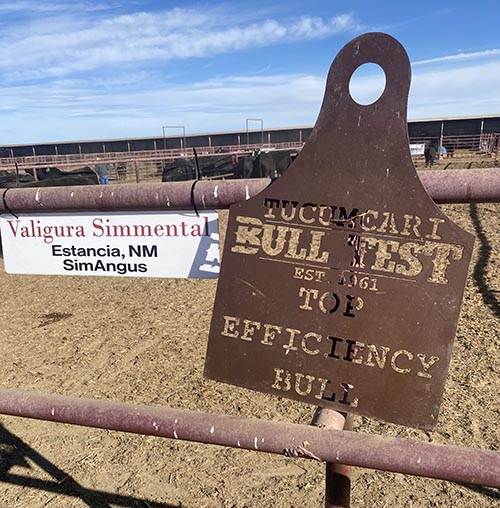
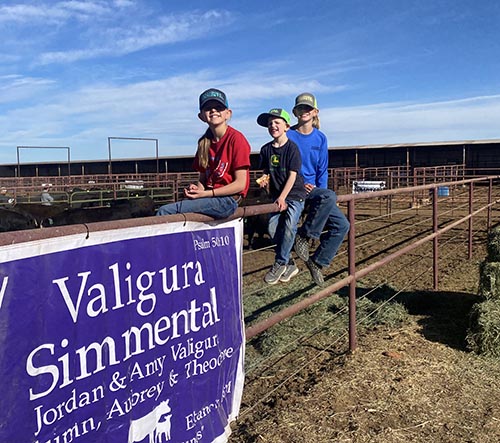
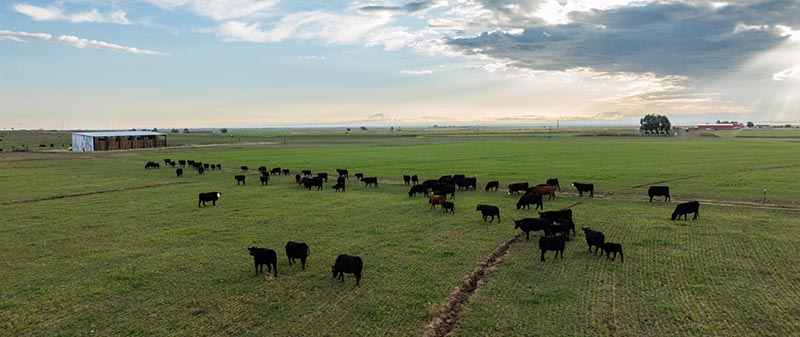
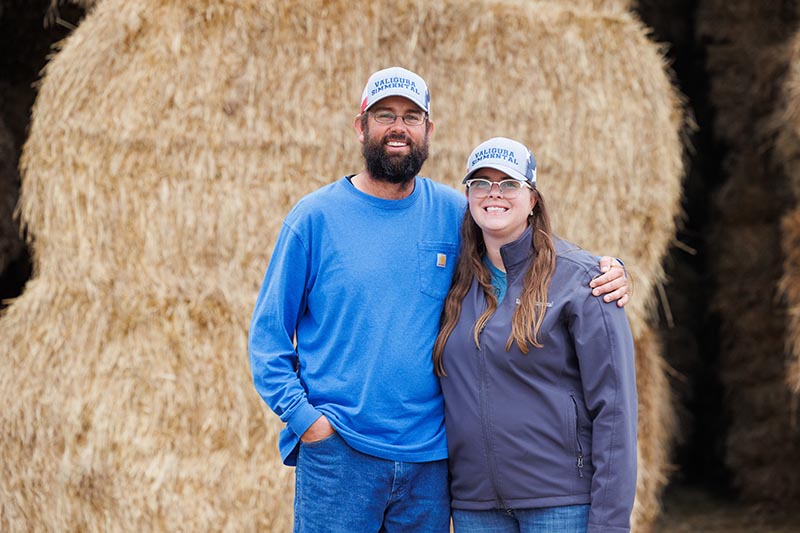
Above: Jordan and Amy’s early focus on farming allowed them to purchase irrigated ground. From top: Jordan and Amy Valigura. Valigura Simmental has participated in the Tucumcari Bull Test for the past five years, with their bulls topping the test several times. Autumn, Aubrey, and Theodore Valigura help their parents with daily tasks on the ranch.
Elevating Simmental The Simmental breed is less common in New Mexico, which is something the Valiguras want to change. “It’s a common misconception in our state that Simmental is this big orange cow with calving problems,”
Jordan said.
The state is especially arid and harsh, which Jordan sees as a major opportunity for the breed. “All around us, even the Angus breeders around us, are bucking the trends,” he said.
Selling high-quality bulls and participating in the Tucumcari Bull Test are two things the Valiguras are actively doing to increase the prevalence of Simmental in New Mexico. “Bulls are put on a feed efficiency test, and then marketed through a sale in March. They test around 220 bulls per year, and we get to see how ours compete against the other breeds,” Jordan said.
The Tucumcari Bull Test, organized by New Mexico State University, is the longest-running test in the country. Their bulls have excelled at the test, topping it several times. Valigura Simmental has participated in the test for five years now, and it is something they plan to continue having a strong presence in. Additionally, Valigura Simmental sells 15 to 30 head of bulls by private treaty.
While feed efficiency is just one of many traits Jordan finds value in, he sees the program as a way to make sure their genetics are stacking up against other producers. While gain and final product are a commonfocus, Jordan maintains a focus on balance and maternal traits, leaning toward the belief that one animal or set of genetics cannot do everything. “I’m more of the mindset that you have maternally focused animals, and more terminal animals,” Jordan explained.
At home, bulls are developed to fit their future environments on commercial operations. “They are prepared to go anywhere in the state of New Mexico. Last year, we sold two bulls to a friend running 200 cows on 80,000 acres. He has been really happy with them. Our bulls have to travel, and they have to work for it. I don’t want them to be fat and lazy, so I don’t feed them that way,” Jordan explained.
For the Family
Family is at the heart of everything Jordan and Amy do. Their three children, Autumn, Aubrey, and Theodore, are homeschooled and extremely involved in their daily tasks. Docility is nonnegotiable in the cow herd because of this. “We do it ourselves, as a family,” Amy said. “We set things up so our kids can help. Our cattle are great, so we don’t have to worry about the kids.” Jordan and Amy also value the lessons their children are learning by growing up in agriculture. “We’re getting so caught up in technology, and I feel like we’re losing the heart of everything,” Jordan shared. “We need to know how to grow food, and how to feed ourselves. It’s our job as parents to teach our kids that.” The road to building a place in the beef industry has required resilience and creativity, but the Valigura family sees it as a part of a larger picture. “We have always felt like God brought us here,” Amy concluded. “We really feel like we belong here, even when it gets hard.”