Cattle Markets: Same Story, Next Chapter
by Derrell S. Peel, Oklahoma State University Extension
The cattle report released by USDA in late January does nothing to change the strong fundamentals driving cattle markets.
Nearly all inventory categories were down year-over-year, including the all cattle and calves total, down 0.4% compared to last year. The 2025 calf crop was smaller than earlier projections at 32.9 million head, the smallest since 1941.
Of the most significance, and slightly surprising, is that the beef cow herd decreased another 1% year-over-year, as of January 1, 2026. The beef cow inventory now stands at 27.61 million head, the smallest since 1961. Since the cyclical peak in 2019, at 31.64 million, the beef cow herd has decreased 4.03 million, a total seven-year drop of 12.7%. The 2026 low extends the current cattle cycle to 12 years since the previous low in 2014. Although this is likely to be the cyclical low, it will not be confirmed until next year. The July cattle report may provide additional guidance.
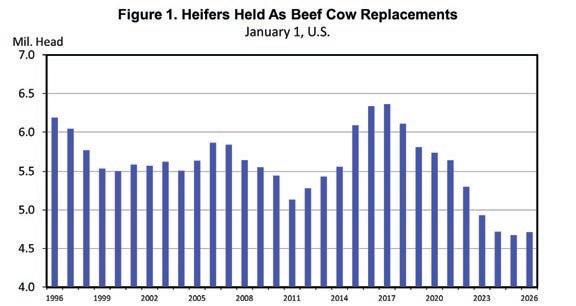
The inventory of beef replacement heifers was up slightly, by 0.9% year-over-year, which is the first increase in beef replacement heifers in nine years, since the previous peak in 2017 (Figure 1). The tiny increase in beef replacement heifers is consistent with recent indications of a minor amount of heifer retention, but is not enough to signal any beef cow herd growth. If anything, it indicates stabilization of the herd at current levels in anticipation of potential future growth.
All categories of feeder cattle were down year-over-year, including steers less than 500 pounds, down 0.6%; other heifers less than 500 pounds, down 1.5% ; and calves over 500 pounds, down 0.1%. However, total feedlot inventories were down 3.3% year-over-year. Thus, the calculated supply of feeder cattle outside of feedlots on January 1 was up 0.9%. This does not mean there are more feeder cattle in the country, but simply that a few more of the smaller supply from last year has yet to be placed in feedlots.
Little, if any, beef cow herd growth is possible in 2026. It will depend on beef cow slaughter and herd culling. Beef cow slaughter decreased 40.5% in three years from 2022–2025, leading to a net culling rate of 8.4% in 2025. This low culling rate means that older cows will need to be culled going forward. Beef cow slaughter is expected to stabilize, or perhaps increase some in 2026. That means that the slight increase in beef replacement heifers will be needed just to maintain the current herd or, at most, increase fractionally in 2026.
Once again, the industry is waiting for indications of significant beef heifer retention that would indicate potential beef herd growth. Tight cattle supplies will continue to support cattle prices, likely pushing prices higher. When increased heifer retention occurs, supplies will tighten further, pushing prices even higher. This, of course, is predicated on continued strong beef demand, which shows no sign of weakening at this point.
Add Magnesium to Prevent Grass Tetany in Cattle
“As spring and lush grass growth arrives, cattle producers need to plan for prevention of grass tetany,” says Patrick Davis, University of Missouri Extension livestock field specialist. Grass tetany arises from a cattle mineral imbalance, so Davis suggests cattle producers use management strategies discussed below to reduce the incidence in their cattle operations.
“A balanced mineral program with added magnesium will prevent grass tetany,” says Davis. Lush forages have a combination of high potassium and low sodium, which reduces animal absorption of magnesium, resulting in symptoms of grass tetany. In addition to magnesium deficiency, evidence shows that sodium deficiency plays a role in grass tetany. Davis suggests cattle producers provide a balanced mineral, vitamin, and trace mineral program free-choice with an added magnesium level of 12% to 14% to prevent against grass tetany. It is preferred to add the extra magnesium in the form of magnesium oxide starting about 30 days before green-up.
“Older, early lactation cows are the most susceptible to experience grass tetany,” says Davis. Milk production is a big drain on magnesium, and older early lactation cows have reduced ability to mobilize bone magnesium and maintain optimum blood levels. Davis suggests cattle producers pay close attention to this group of cows and watch for grass tetany symptoms, which consist of unusual behavior, muscle tremors, frequent urination, staggers, convulsions and, if not treated, death.
Davis suggests prevention to deal with grass tetany, but have a plan in place if symptoms arise. Consult your veterinarian on treatment strategies if your cattle experience symptoms. Treatment consists of intravenous injection of a commercial preparation of magnesium and calcium in a dextrose base. Treatment results will vary based on the animal’s clinical stage at treatment.
Davis suggests cattle producers who want more information on management strategies to reduce the incidence of cattle grass tetany contact their local Extension livestock field specialist.
Calving Management to Reduce Disease Risk
Rosslyn Biggs, DVM, Oklahoma State University Extension
Calf scours remains one of the most common health challenges facing cow-calf producers, and is rarely caused by a single factor. Instead, diarrhea results from the interaction between disease-causing organisms, the calf, and its environment. One management approach designed to address environmental exposure during calving is the Sandhills calving system. This system focuses on maintaining clean calving conditions throughout the entire calving season.
Early in the calving season, cows typically calve on clean ground with no older calves present. As calving progresses, disease risk increases as pathogens accumulate and younger calves are exposed to older calves shedding infectious organisms. The Sandhills system works to recreate early-season conditions week after week. All pregnant cows begin the season in one pasture. After one to two weeks, cows that have not yet calved are moved to a clean pasture, while cow-calf pairs remain behind. This process is repeated throughout the calving season.
By separating calves by age, younger calves have limited contact with older calves that may be shedding pathogens. This disrupts the cycle of exposure and reduces the buildup of disease-causing organisms in the calving area. Producers who adopt this system often report fewer cases of calf scours, reduced treatment rates, and improved calf survival. These benefits can also translate into lower labor demands and decreased treatment costs.
Additional advantages include improved observation and recordkeeping. Smaller groups of cow-calf pairs allow producers to monitor health more closely, identify problems earlier, and provide targeted care when needed. The system can also support broader biosecurity efforts, including isolation of sick calves and maintaining cleaner calving areas.
Implementing the Sandhills calving system does require advanced planning. Pasture availability, water access, shelter, forage use, and weather conditions must be considered. Timing and good stockmanship are especially important when moving pregnant cows. While not a replacement for sound nutrition, vaccination, or overall herd health programs, this system is a valuable management tool. For producers facing recurring calf scours or seeking to improve calving-season efficiency, the Sandhills calving system is worth consideration as a proactive investment in calf health and herd productivity.
Why Your Chute-Side Manner Matters
by Andrea Bedford, Bovine Veterinarian
Good chute-side manner isn’t just about efficiency; it’s about how cattle experience handling, how accurately treatments are delivered, and how safely people can work. During a chute-side demonstration at CattleCon in Nashville, Tennessee, Ron Gill and Paige Pratt emphasized that many of the most common problems seen later — leakage, injection-site reactions, poor efficacy, and safety risks — start with small decisions made at the chute.
From how handlers move around cattle to how needles and syringes are selected and used, chute-side technique plays a central role in animal welfare and Beef Quality Assurance outcomes.
Movement Around the Cow in the Chute Matters
Handlers continue to influence cattle behavior even after the headgate closes. Gill showed how small changes in handler position — stepping forward, stepping back or changing angle — can prompt cattle to adjust their stance and head position. Using your movement when the animal is inside the chute can improve neck access and reduce resistance, allowing procedures to be performed more calmly and accurately without escalating stress. “One thing you can do a lot of times, you can step forward,” says Gill, who proceeded to move to the front of the cow. “Notice that the animal steps back when I do that, and then I’ve got better neck access.”
Proper Restraint Determines Accuracy and Safety
Accurate injections and safe handling depend on adequate restraint. When cattle are not properly positioned, injections are more likely to leak or be misplaced and handlers are placed at greater risk. The speakers caution against leaning into crowded or partially restrained animals and emphasize that rushing procedures undermines both safety and efficacy. “If you have to lean over in there to give a shot and one of them throws her head up or jumps, then that’s where people get hurt,” says Gill, who advises against working cattle in line for the chute without restraint, even if they’re packed in tight.
Needle and Syringe Selection Is a Chute-Side Decision
Choosing the correct needle and syringe is part of chute-side technique, not an afterthought. Needle gauge and length must match cattle size, skin thickness, and injection route. Inappropriate needle selection or damaged equipment increases pain, leakage, and treatment failure, particularly when combined with poor restraint or rushed technique. “The lighter those cattle are, probably the smaller gauge, the smaller diameter we want,” says Pratt. She also highlights the importance of needle length, to make sure the injectable is getting to the right depth, and syringe tip style, favoring Luer lock.
How Syringes Are Handled Affects Whether Products Work
Syringe handling influences dosing accuracy and product effectiveness. Common chute-side mistakes include exposure to sunlight, contamination during filling and improper cleaning practices. These errors can reduce vaccine efficacy before the product ever enters the animal, making careful syringe management a critical part of chute-side manner. “Once you sterilize these, don’t be pulling the plunger back until you have a needle in a bottle,” Gill says. “What have you just done? You sucked all the dust out of the corral into your syringe.”
Chute-Side Manner Reflects Management Priorities
Chute-side habits reflect how seriously an operation takes stewardship and animal welfare. Consistent techniques such as using the same locations, spacing injections appropriately, and avoiding shortcuts help prevent long-term problems such as abscesses and lost performance. “If you’re going to be doing it, spending the money, do it correctly,” Gill says.
Refining these small chute-side decisions ensures that every animal is treated with the respect it deserves and every investment is given the best chance to succeed.