

by Dr. Wade Shafer
Paradox — a situation that seems contradictory at first glance, but upon closer examination, reveals a deeper truth that makes sense.
The Paradox
Every cattle producer has seen it. A tiny calf hits the ground. It struggles to stand, nurses poorly, or dies before it ever has much of a chance. After enough of those experiences, it’s reasonable to conclude that small calves are more vulnerable.
Carrying that thought one step further and another conclusion seems almost unavoidable, in fact so much so that it has become conventional wisdom across the industry: if we continue selecting for genetically lower birthweight, we’ll inevitably produce calves that are less likely to survive.
At first glance, that seems perfectly logical. It also creates an interesting paradox:
- Producers routinely observe that exceptionally small calves have lower survival rates.
- Decades of genetic research have produced remarkably little evidence that selecting for lower birthweight reduces calf survival. In fact, in some of the best experimental studies conducted in this area, the evidence points in exactly the opposite direction.
The paradox is that both statements are valid. How can that be? Aren’t they contradictory? Though research in this area doesn’t support the conventional wisdom that selecting for lower birthweights will result in reduced survival, I am not suggesting that producers are imagining things. Small calves often do have poorer survival. However, that does not mean that selection for small calves will result in lower survival rates. The reason lies in a fundamental animal breeding principle that tends to be poorly understood — traits move together due to both genetic and non-genetic effects; however, selection only impacts one — the genetic effect.
What Research Shows
If selecting for lower birthweight truly reduces calf survival, we should expect that conclusion to emerge repeatedly in genetic studies and experimental selection programs. To date, it largely has not.
A widely cited review by Koots and colleagues pooled published genetic correlation estimates between birthweight and calf survival across many studies.1 Taken together, they found little support for the idea that genes for lower birthweight hurt survival — if anything, the pooled estimates leaned the other way.
The most convincing evidence comes from a set of long-term selection experiments run at the US Meat Animal Research Center (USMARC). Rather than just comparing existing cattle populations, researchers led by Gary Bennett built divergent selection lines — breeding specifically for lower birthweight and easier calving while holding growth steady — and tracked the results over multiple generations.2,3
The results, after several generations of selection:
- Calves from the low-birthweight lines were born roughly 8.6 pounds lighter on average — a far bigger shift than any breed has produced through normal selection.
- Those calves required substantially less calving assistance.
- Growth to weaning held steady — lighter birthweight didn’t come at the cost of growth.
- There was no sign that the genetically lighter calves had poorer survival. If anything, survival among calves out of first-calf heifers improved.
A follow-up analysis of those same USMARC lines, published more recently, confirmed the pattern held up over the long run: calves from the low-birthweight, easy-calving lines continued to show less calving difficulty and better survival to weaning, particularly out of first-parity dams — with no meaningful penalty in mature cow productivity.4
These studies do not definitively prove that selecting for lower birthweight improves survival. They do, however, challenge the widely held belief that it necessarily reduces survival. If genetically reducing birthweight inherently produced more vulnerable calves, the USMARC experiments provided an excellent opportunity for that outcome to appear. It did not.
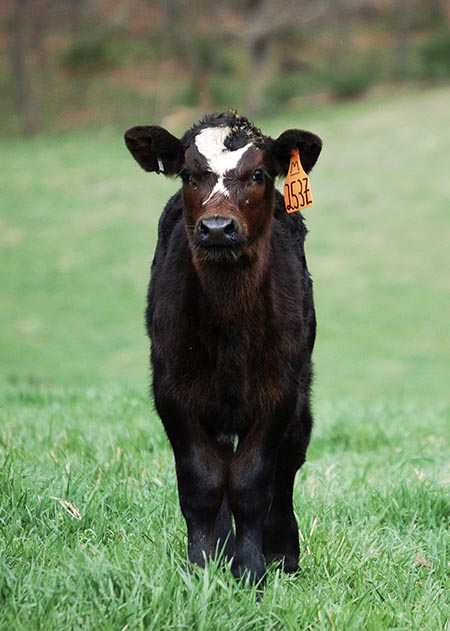
Above: Producers frequently observe that smaller calves have lower survival rates. This could be due to other developmental issues, and not genetics alone. Photo by Hannah Wine.
Reconciling the Paradox
The reasoning usually goes like this: “I’ve seen lots of tiny calves die”; therefore, “If I select for lower birthweight, I will lose more calves.” The first statement is a phenotypic observation. The second is speculation about what has been dubbed correlated response to selection. It is important to know that, and understand why, the second statement cannot be directly deduced from the first.
We have long understood that phenotypes, for most important traits in beef production, are influenced by both genes and environment. Obviously, a calf’s birthweight as well as its ability to survive are a product of both. Just as phenotypes are a combination of genetic and non-genetic effects, so is the relationship between phenotypes.
We all know that many traits are genetically related due to genes that impact one trait also impacting another. What often isn’t understood is that there are also non-genetic relationships between traits. For example, though the age of a calf’s dam is independent of the calf’s genes for growth, we know that calves out of mature dams tend to be heavier at both birth and weaning. This results in a consistent, non-genetic relationship between the traits. The bottom line is though both genetic and non-genetic effects can cause traits to move together, because selection only acts on genes, only the genetic relationship will result in a correlated response to selection.
An explanation for the paradox comes into focus once we recognize that exceptionally light calves are not all light for the same reason. A calf can be born unusually small for many reasons beyond low-birthweight genes. It may have experienced nutritional restriction, placental insufficiency, disease, stress, prematurity, or other developmental limitations during gestation—in other words, it may have been developmentally compromised.
Though they may have been genetically programmed toward small birthweight by chance, I would hardly be going out on a limb in speculating that virtually all of the extremely small, frail calves that struggled shortly after birth—the ones producers remember most vividly—were likely developmentally compromised. Because those calves are memorable, it is easy to mentally associate light birthweights with poor vigor and reduced survival.
Given that the factors causing a calf to be developmentally compromised are non-genetic with respect to the calf, they will not be passed on through selection. That said, because we cannot distinguish whether any individual calf is small due to being environmentally compromised or genetically programmed, the paradox between what producers observe and what studies have found is certainly understandable.

Calves out of older mature dams tend to be heavier than those out of younger dams.
Implications of the Paradox
At this point you might be thinking: even if there’s no real benefit to avoiding low-birthweight sires, what’s the harm in playing it safe?
The harm is that selection is like a budget. Every dollar — every unit of selection pressure — applied to a trait is a dollar that can’t be allocated to something else. If you’re passing over bulls with real genetic merit for growth, carcass value, or fertility because of an unfounded worry about birthweight, you’re spending part of your selection budget on the wrong line item. That’s genetic progress you’re leaving on the table, year after year, calf crop after calf crop. And if the true relationship runs the other direction, avoiding those bulls could be quietly working against the very outcome you’re trying to protect from.
Path Forward
As I’ve mentioned, available evidence does not justify the conclusion that selecting for lower birthweight compromises calf survival. Neither does it suggest that we have a thorough understanding of the relationship. Perinatal survival is one of the most economically important traits in beef production, and birthweight is one of the most routinely recorded. That combination makes further research into their relationship especially valuable. A more thorough understanding will allow us to objectively, and therefore more effectively, leverage the relationship between birthweight and survival.
Once we have a more thorough understanding of the relationship, it need not remain extraneous to the established genetic evaluation infrastructure—requiring breeders to make ad-hoc selection decisions. The relationship should be incorporated into economic selection indices to ensure that it be most effectively leveraged for selection, i.e., to ensure we’re getting the most bang for our buck out of our “selection budget.”
General Takeaway
What I’ve described above is true of all trait combinations. The birthweight/survival paradox is simply an interesting and revealing example of a much broader principle in animal breeding — in a nutshell, what we see isn’t necessarily what we get genetically! Just as we can’t guarantee that an animal with a heavy weaning weight possesses genes for heavy weight at weaning, due to non-genetic factors, we can’t be certain that traits that move together are genetically related. Understanding that may be one of the most valuable principles one can learn in animal breeding.
Footnotes
- Koots, K. R., J. P. Gibson, C. Smith, and J. W. Wilton. 1994. Analyses of published genetic parameter estimates for beef production traits. II. Phenotypic and genetic correlations. Anim. Breed. Abstr. 62:825–853.
- Bennett, G. L. 2008. Experimental selection for calving ease and postnatal growth in seven cattle populations. I. Changes in estimated breeding values. J. Anim. Sci. 86:2093–2102.
- Bennett, G. L., R. M. Thallman, W. M. Snelling, and L. A. Kuehn. 2008. Experimental selection for calving ease and postnatal growth in seven cattle populations. II. Phenotypic differences. J. Anim. Sci. 86:2103–2114.
- Thallman, R. M., et al. 2021. Genetic changes in beef cow traits following selection for calving ease. Transl. Anim. Sci. 5(1):txab009.