What Your Customers Really Thinking?
by Lilly Platts
Dr. Charley Martiniez shared his research on bull buying behavior during Fall Focus 2025.
In addition to presenting past research, Martinez hosted an on-site study. The results of this study were compiled immediately before his presentation, offering real-time, in-person insight.
Editor’s note: This is the second of a two-part series. See part one in the February issue of the Register
With the help of graduate students, computers with the eye-tracking software were set up outside the conference room during the day-long Fall Focus educational symposium. Throughout the day, attendees were asked if they wanted to participate in a bull buying simulation, with Martinez and his graduate students walking each through signup and the process. In total, 100 people participated in the study throughout the day.
Each participant was offered a small sum of money for participating, with the addition of a bonus for each person who answered each bull selection question correctly. Paying participants a moderate sum to participate in a study is standard practice in research. The dollar amount is typically too low to be a primary motivator, but it does compensate each person for their time, and convey the importance of taking the process seriously.
During the Fall Focus study, Dr. Martinez and his students were set up throughout most of the day. When participants sat down, they went through a quick eye calibration process, in order for the computers to accurately track where their eyes were going during the study.

Attendees of Fall Focus 2025 had the opportunity to also participate in Dr. Martinez’s on-site bull buying study.
Like in past studies Martinez has organized, participants were asked demographic questions, like if their primary income is from the cattle business, age, how much money they make, etc. They were also asked behavior questions, which gauged their risk aversion, tolerance, and patience.
The bull selection process at Fall Focus was especially insightful for SimGenetics producers, with the focus being placed on $TI. Participants were not explicitly told to use $TI as their primary selection tool, and were instead presented with the following scenario: You are consulting a producer with 35 cows, who retains every calf through their feed yard. Profit is their primary objective, and they want a bull ranked in the upper third for the breed. Can you find a bull out of the pair, or neither, that matches their goals?
As each participant worked through the selection process, they were presented with two bulls on each screen. Half of the participants were given percentile rank under, and the rest were not. For the first bull that was presented, for example, half of the participants saw that the first bull was in the top 1% for $TI, and the second was in the bottom 70th percentile. This percentile rank made the selection fairly simple, with bull one being the best choice.
Some bulls were closer in their $TI EPD and/or ranking, and participants were also looking out for pairs of bulls where neither matched. As each participant worked through the pairs of bulls, they simply clicked on a multiple choice list, which was consistent throughout, where they could choose Bull A, Bull B, or neither.
Some selections were easier than others. In the fourth set of bulls, Bull A was in the 50th percentile for $TI, and Bull B was in the 60th. “Neither” was the correct answer, but many participants were tripped up by this pair. Martinez shared what the eye tracking record looked like for one person, which revealed more time spent on the page, and the person ultimately looking at $API as well. As Martinez shared, this data doesn’t share any actual reasoning behind the behavior, but it would be plausible to assume that once the $TI choice wasn’t as obvious as with the previous bulls, this person went to $API as a secondary tool.
Martinez pooled the results of the day, and presented summary statistics for the study. For the first set of bulls, which presented very different $TI for the two bulls, the participants who saw percentile rank and those who didn’t were similarly successful in choosing the right bull. In set four, only 17% of people without percentile rank picked the right bull, and 62% with percentile rank picked the right choice. “Whenever it’s a closer decision, like set four was designed to be, information matters,” Martinez said. “The percentile rank allowed people to make that decision.”
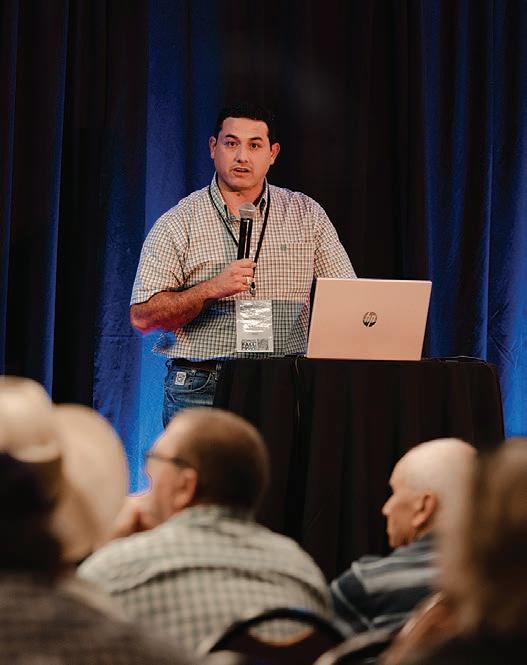
Dr. Charley Martinez presented his research on bull buying behavior during Fall Focus 2025.
Martinez shared that he created set four to prove that while his previous research has shown percentile rank not being widely used, it is significant. In set four, the participants with percentile rank were given an extra tool for choosing between two bulls that were not a fit for the scenario.
Participants were asked if they use genomically enhanced EPD in their real-life decisions. The large majority said yes, which Martinez shared is much higher than what he typically sees when surveying producers. The setting — a science-focused educational symposium — lends to this, with progressive producers typically being drawn to this type of event.
With percentile rank, 14% got all of the selections right, with 11% without percentile rank being correct throughout. Out of all participants, 13% were accurate throughout. The questionnaire also asked participants the following question: “Is 99% or 1% higher/better when looking at an EPD rank?”. Only 83% of participants picked the correct choice. This is especially revealing, since understanding of this is fundamental to a person’s ability to sort through EPD and percentile rankings. Martinez shared that results like this prove the need for education. “For those of us in academia and Extension, that is something we have to work on. If we’re going to continue pushing these EPD, we have to do our jobs in terms of making sure you know what they mean,” he said.

A herd bull’s genetic impact on an operation exceeds their average service life. Because of this, making the best choice is critical for long-term success.
Martinez concluded that the study at Fall Focus, which primarily targeted the use of $TI and percentile rankings, added valuable information to his team’s larger pool of research. Past studies focused on the ability to accurately predict the value of animals, and the addition of data on specific selection criteria, is valuable. Linking behavior to measurable data is difficult in the beef industry, and seeing results the day-of was especially insightful, and interesting, for participants at Fall Focus. Martinez concluded, “The key takeaway today is that percentile ranks do help.”
Dr. Charley Martinez, University of Tennessee, explains how bull buyers make purchase decisions when scanning sale videos and catalogs. Learn about this interesting study and what visual cues and genetic information garner the most attention.