Beef × Dairy Crossbred Management to Enhance Profitability, Resource Efficiency, and Sustainability in Beef Systems
Paul Beck, Oklahoma State University Extension
The US beef cow herd is at historic lows, increasing the need for reliable sources of high-quality beef, reducing feeder cattle availability, and making challenging break-evens for cattle feeders.
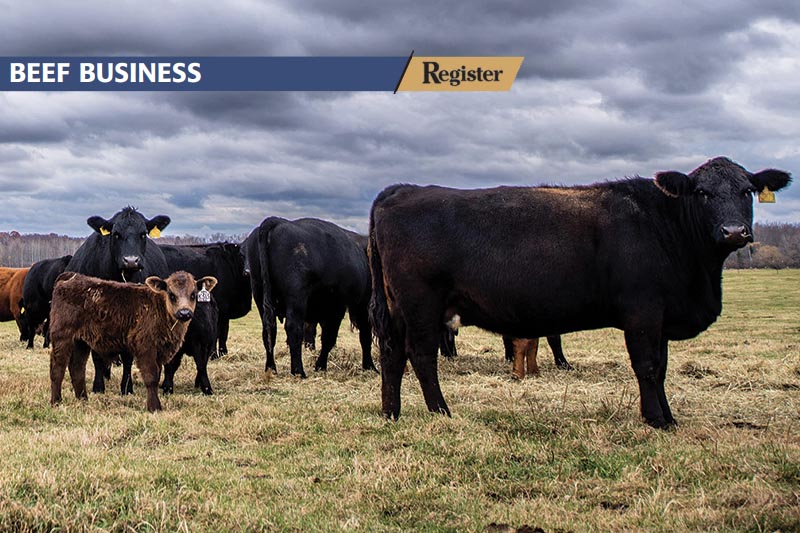
One of the most promising solutions is the growing use of beef-on-dairy crossbred calves, made possible by advances in reproductive technology that allow dairy producers to create replacement heifers from elite cows and breed the remainder to beef sires. The resulting crossbreds consistently show better growth, efficiency, carcass quality, and health than traditional dairy-type calves, providing value for dairies and cattle feeders.
To help producers understand how to best manage these calves and evaluate their economic potential, our team launched a coordinated research and Extension program following beef-ondairy steers from birth through harvest. Studies at both research and commercial scales evaluated how preweaning nutritional level, post-weaning management programs, and finishing systems affect gain, feed efficiency, carcass traits, profitability, and greenhouse gas emissions. Economic modeling showed that dairy-beef steers can be as profitable as native beef, even with slightly higher feed costs. A Life-Cycle Analysis showed that calffed management reduced carbon footprint by 4.6% to 11.3% compared with yearling-fed systems. When emissions of the dairy cow were allocated primarily to milk production, the overall greenhouse gas intensity of dairy-beef systems was lower than that of native beef.
Extension outreach played a major role in delivering these findings to producers. Information was shared through field days, fact sheets, the Ranchers Thursday Lunchtime Webinar Series, and regional programs such as the Five States Beef Conference. More than 10,000 producers, educators, and industry professionals have participated in program events or used the online resources. Peer-reviewed publications, public datasets, and media coverage further expanded the program’s reach.
The results are already influencing production decisions. Follow-up evaluations show improved producer confidence and adoption of recommended feeding and management strategies, especially in feedlots across Oklahoma and Texas. The work has improved cooperation between the beef and dairy sectors and increased understanding of how to raise crossbred calves efficiently while reducing their environmental footprint.
How to Manage Coccidiosis Risk in Weaned Calves: What Producers Need to Know
by Maddy Kruger, Bovine Veterinarian
A ranch weans four groups of calves, all from separate pastures and breeding groups. They are placed in the same dry lot to be fed, and three weeks later, some calves are dealing with bloody diarrhea. With the time of year and situation described, coccidiosis is high on the list of possible issues.
In the most recent episode of the “Bovine Science with BCI” podcast, Kansas State University veterinarians Bob Larson and
Brad White look at this case of potential coccidiosis in weaned calves. Larson explains there are other issues that can cause bloody diarrhea, like Salmonella or any other intestinal disease that cause damage to the intestinal lining.
One of the first factors to investigate is feed rations. In this case, these calves were being fed a corn, corn-gluten, and soy hull mix with free-choice hay. Larson explains this is a rather fibrous diet with less starch, therefore acidosis and other related digestive tract issues can be eliminated.
The Prognosis
Studying the feces is another way to analyze the situation. Typical signs of acidosis include runny feces, sometimes containing gas bubbles, according to Larson. But he also adds that this is never a perfect test and to keep your options open when determining the prognosis.
To further understand feces tests, Larson explains that frank blood, often appearing bright red in color, indicates the damaged gut is further back in the digestive tract and the blood hasn’t been digested. When the blood is digested, like with abomasum ulcers or earlier tract issues, it appears black in color with a tar-like texture. In this ranch’s case, calves are presenting frank blood.
For more diagnostics, Larson says fecal floats are an option. There are different types of Coccidia organisms that infect cattle in varying strengths. He warns these protozoa of the Coccidia organisms will invade into the cells that line the intestine and then destroy the intestine as they multiply. But sometimes these protozoa do not show up in a fecal float, so it is important to not rule out coccidiosis if that is what is suspected, and the fecal float is negative.
White adds most calves will have Coccidia organisms in their systems already. Larson explains it is common for most mammals to have these organisms present in their systems, and the Coccidia are specific to animal species. So, a high number of these organisms would confidently indicate coccidiosis, but smaller numbers should not be overlooked either.
Larson and White both agree coccidiosis seems to be the issue with this ranch’s case, so the next item to address is where or how the calves contract it.
Control and Prevention
“They had it themselves — it’s not that they got it from somebody else necessarily,” Larson explains.
But he notes cattle can still get sick if they encounter calves carrying a Coccidia species they haven’t been exposed to. Young cattle like these are more susceptible to Coccidia protozoa because they haven’t had time to build an immunity to them like older cattle would. However, there are a variety of populations of Coccidia, so they cannot build an immunity to all types.
“There’s some challenges there keeping everybody on track nutritionally, and I’m mixing cattle from different sources, which probably means they are bringing in different types of Coccidia,” Larson says.
White adds Coccidia can be spread by fecal or oral contamination, and this setting is ideal for it. However, he also mentions their ration has an ionophore in it that should help control the contamination.
Rumensin or Bovitech are common ionophore products that provide control, but Larson says we should think of them as ways to control the multiplication of organisms. If cattle are at high levels of protozoa already, these additives are ineffective. But they are a crucial part of control and prevention.
For early precautions, Larson recommends feeding ionophore products like Decoquinate or Amprolium as they “will do a better job of killing those organisms at other stages in the life cycle.”
Once calves are settled from weaning and their stress levels decrease, then they can be switched to other ionophores in their daily rations. Larson says these treatments can be administered in feed or water, but it is often better to treat individual animals. Then, the whole group can be started on the ionophores for further prevention.
Managing environments and their conditions and limiting nutritional and weaning stress is also beneficial in the prevention of coccidiosis. Larson reminds producers: “It takes consistent attention to the details to try to keep these problems at bay.”
The Impact of Tyson’s Closure on Beef Slaughter Capacity Utilization
Southern Ag Today
This year, there have been several Southern Ag Today articles discussing the impacts of tight fed cattle supplies on prices, cattle on feed, slaughter weights, and total beef production (Anderson 2025a, Anderson 2025b, Maples 2025). On November 21, 2025, Tyson announced that they would be closing their Lexington, Nebraska, plant in January 2026. Following the announcement, there have been a lot of questions revolving around the impact of the closure on national slaughter capacity utilization (CU).
The Lexington, Nebraska, plant had an approximate daily capacity of 5,000 head. That equates to approximately 20% of Tyson’s daily capacity (25,800 head/day) as a company. In Martinez et al. (2023), we showed a measure of national slaughter capacity utilization, which measures the ratio of operational cattle slaughter capacity over total physical capacity. To estimate the impact of the closure on the national CU, we use 2025’s monthly slaughter with an adjusted 2025 slaughter CU. The adjusted CU is simply adjusting the national CU with the daily 5,000 head taken out. Figure 1 displays the monthly national federally inspected (FI) slaughter capacity utilization with the previous five-year average (thick blue line), 2024 (orange dotted line), 2025 (grey thin line), and 2025-Adjusted (green dashed line).
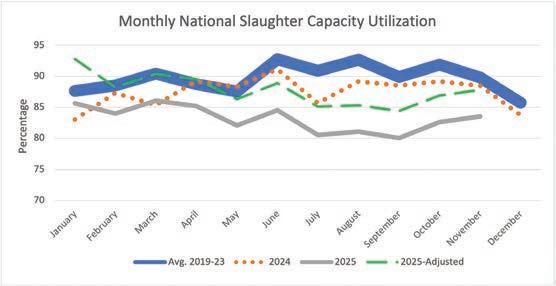
The adjusted capacity utilization is closer to the previous five-year average. Evaluating data through November, the average for the five-year average was 90.1%, while the 2025 and 2025-adjusted average through November are 83.1% and 87.7%, respectively. In November, slaughter capacity utilization averaged 83.5%, which was lower than November 2024
(88.4%), the previous five-year average (89.8%), and the 2025adjusted (87.8%). Overall, 2025 has seen declining fed cattle numbers in the cattle on feed reports and higher fed cattle prices, leading to low or negative packer margins. While the supply chain is offsetting tight cattle supplies with larger carcasses, the closure of the Lexington plant certainly signals there is excess capacity at this time.
This is the first large-scale plant to close since 2013, when Cargill closed their Plainview, Texas, plant, which was also during a time when cattle supplies were tight. There have been reports that Tyson is looking to buy that Plainview plant. Additionally, there are some plants that are reported to come online in 2026 and 2027. It is fair to question if the adjusted capacity utilization is a new norm, or simply a short-run adjustment by the supply chain.
References:
Anderson, David. “Fewer Marketings, Tighter Beef Supplies.” Southern Ag Today 5(26.2). June 24, 2025.
Anderson, David. “Working Less on Friday!” Southern Ag Today 5(21.2). May 20, 2025.
Maples, Josh. “Cattle Prices Hit New Highs and Carcass Grading Trends Over Time.” Southern Ag Today 5(19.2). May 6, 2025.
Martinez, C., Li, P., Boyer, C. N., Yu, T. E., & Maples, J. G. (2023). Beef price spread relationship with processing capacity utilization. Journal of the Agricultural and Applied Economics Association. https://onlinelibrary.wiley.com/doi/full/10.1002/jaa2.48 .