by Lilly Platts
Located on the Oklahoma-Texas border, Estes Ranch has found success harnessing the hardiness, growth, and adaptability of Simbrah cattle.
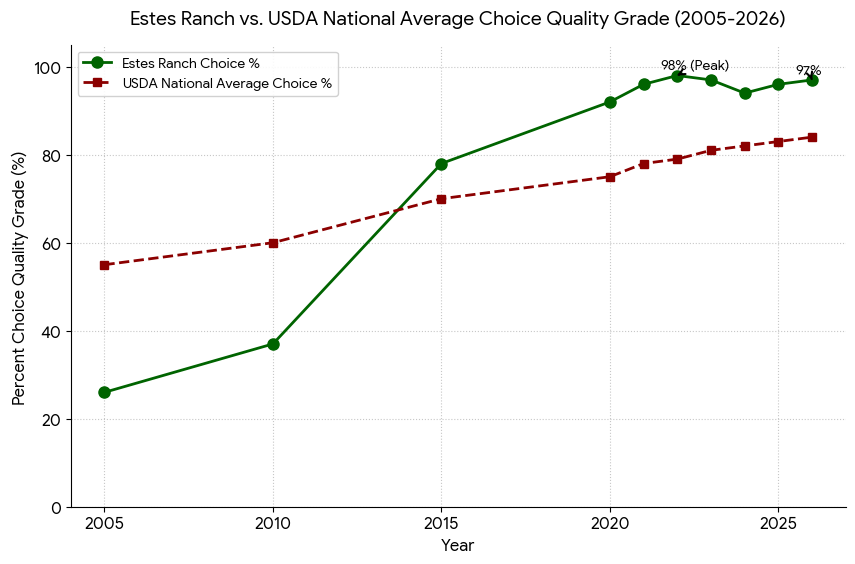
Through intense culling, detailed data collection, and a focus on value-added traits, Estes Ranch is producing cattle that have graded Choice at a rate of 92% or better the last five years, pushing against the belief that Simbrah cattle fall short on the rail. The addition of purebred Simmental and Fleckvieh cattle has made Estes Ranch a trusted source for genetics, with their market share growing each year. Ben Estes is the sixth generation of the family operation, and is raising his family on the ranch.
Oklahoma and Texas Roots
The Estes family settled on the Oklahoma-Texas line, near Wellington, Texas, and Vinson, Oklahoma, in 1897. Like many ranches in the West, Hereford cattle made up the majority of the herd for many years, in the 1960s Angus bulls were purchased to add the first dose of hybrid vigor to the calves. In 1978, wanting to add growth to the commercial cow herd, the family purchased their first Simmental bulls. The hybrid vigor from the Simmental was notable compared to the English cross the family had relied on.
The Simmental breed offered both the performance and color the Estes family was looking for. Ben’s family wanted to add growth to their herd. “Cows were pretty small, and didn’t have much growth or performance,” he recalled his family sharing. “They sought out a breed that they thought would add this growth, but they also wanted to keep the red-and-white-face characteristics of the Hereford, which seemed to work better in our climate.”
This cross added growth to the calf crop, and also improved the cows. “The females were really good, and formed the base of our cow herd,” Ben added. “Some of our genetics to this day trace back to those original cows.”
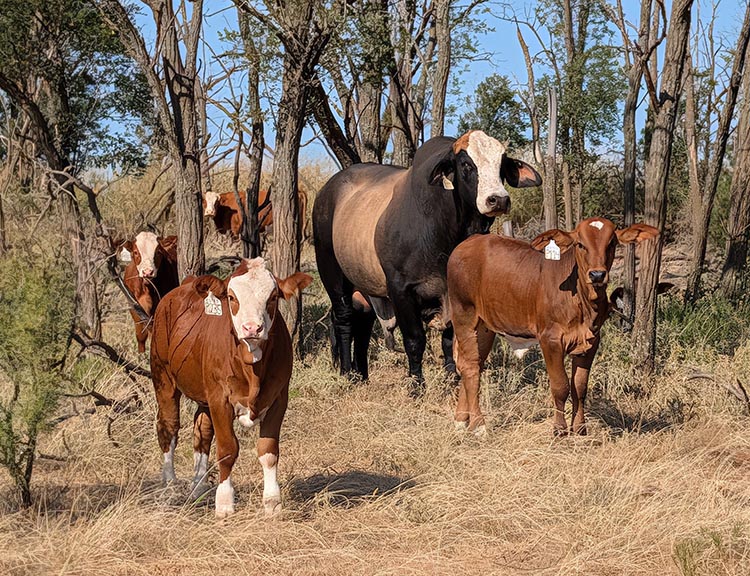
Around this time, the family leased adjoining land to the ranch, and Ben’s grandfather Bill stocked those pastures with Brahman-influenced cows. “Those cows performed and did really well when mated to our Simmental bulls,” Ben recalled. “They noticed the heat tolerance, insect resistance, and just how durable and efficient they were for this country.”
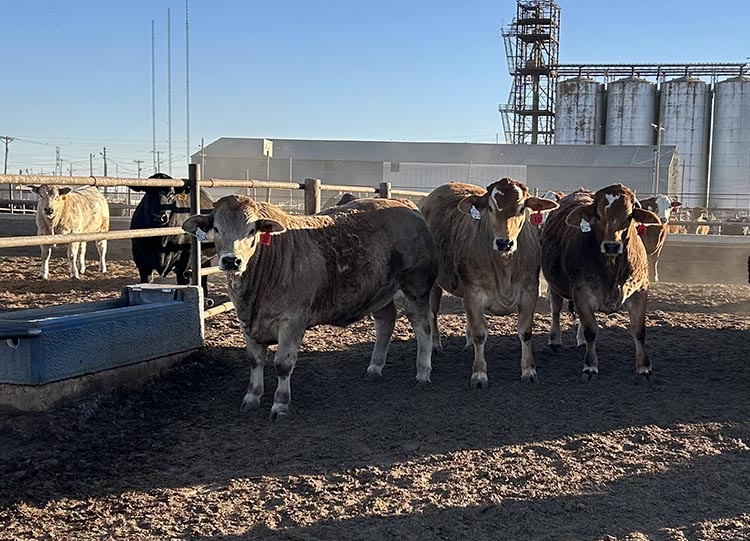
Estes Ranch has been closely tracking carcass data for many years, and through careful selection has drastically improved carcass quality.
During this period, Ben’s father, Paul, was finishing college, and returning to the family ranch. He purchased a group of registered Simmental females to start the seedstock herd. Simbrah cattle are known for their hardiness and adaptability, specially in arid environments. The Texas Panhandle and western Oklahoma will experience long bouts of hot, dry weather with no rain during a normal year, and drought can be especially challenging.
In 1986, the Estes family purchased two three-quarter Brahman, one-quarter Simmental bulls from the RA Brown Ranch, solidifying their focus on Simbrah cattle.
Today, the Estes Ranch runs 150 registered Fleckviehand purebred Simmental females, and 300 registered and commercial Simbrah cows.
Refining the Program
Matching cattle to their environment without sacrificing performance is a consistent focus for all producers, and can be especially challenging in harsh areas. In the South, drought, insects, and heat can be especially challenging. The Simbrah cross — Simmental and Brahman — started as a way to combine the growth, carcass quality, and maternal strengths of the Simmental breed with the adaptability, hardiness, longevity, and heat tolerance of Brahman cattle.
Refining Simbrah genetics to perform on the ranch and the rail has been a consistent focus at the Estes Ranch. The family first started retaining ownership and feeding out calves in the 1990s as a way to participate in value added programs. One of the first programs the family participated in required a Choice grade or better. The first set of data they received on a calf crop revealed that only 26% of the calf crop was meeting this requirement.
This initiated an intense focus on improving their carcass quality without sacrificing the other positive attributes
of the Simbrah cattle. “A negative stereotype of Brahman influenced cattle is that they don’t grade,” Ben explained. “We decided we were going to fix that.”
Their approach included sourcing carcass-oriented genetics, intense culling, and detailed data collection. Ben’s affinity for data started early, and went hand-in hand with the ranch’s goals. “During my freshman year of high school, gathering carcass data and information on our cow herd was my supervised agriculture experience for FFA. I received the Star Farmer award for Oklahoma by the time I was a senior because of how much data I had collected,” he recalled.
From birth through weaning, data was collected on each calf and tied to the dam and sire. Each calf was weighed individually at weaning, and followed through the feeding process. At the end, this information was tied to the final carcass data on the rail. “We knew how each calf performed, and would make culling decisions in the cow herd based on that information,” Ben explained.
If a female’s calf underperformed, she was given the benefit of the doubt, assuming the wrong mating was chosen or an environmental factor hindered her calf’s performance. If her calf fell short the second year, the female would be culled. Each first-calf heifer’s calf was sent to the feedlot, regardless of sex, which prevented any underperforming females from slipping into the program early on.
The result has been cattle that grade at 95% Choice or better, with last year’s group grading 30% Prime. As the quality grades have gone up, Ben has shifted more focus to other carcass traits, like yield grade. Throughout the years, Estes Ranch rarely has Yield Grade 5s, and is currently focusing on no longer seeing a Yield Grade 4.
While data and performance are paramount at Estes Ranch, phenotype is still a priority. “I want an animal you can look at first, and then they have to perform,” Ben said.
Identifying Opportunities
Having proved that Simbrah cattle can perform in the feedlot and grade, Ben sees an opportunity for other producers to add the cross to their programs. “We have found that compared to other breeds, and especially other Brahman crosses, the Simbrah cow does the best. The Simbrah cow is the best female on Earth,” he shared.
Input costs are critical in areas where resources are limited, and Simbrah cows are especially thrifty. “We are very low-input, and live in an arid, minimal rainfall area. Our cows are extremely low-maintenance. We do not feed hay,” Ben said.
Simbrah calves consistently outperform their purebred counterparts, weighing 100 to 150 pounds more at weaning, with their mothers requiring less input. “They require less maintenance than the purebred cows, and the purebred cows probably require a bit more feed to do the same job,” Ben explained.
Ben sees an opportunity for producers in the South and other regions to take advantage of the performance and thriftiness of Simbrah cattle. He also believes these cattle could be more widely used in the South. “Promoting the Simbrah cow to the rest of the country is something we’re passionate about,” Ben shared. “We feel like it’s a hidden secret.”
In the South, Brahman cattle are common, but planned crossbreeding systems are underutilized. “A lot of producers are just running crossbred cows, and if they ran more of a straight F1 Simbrah cow, with two breeds, they could better maximize their heterosis,” Ben shared.
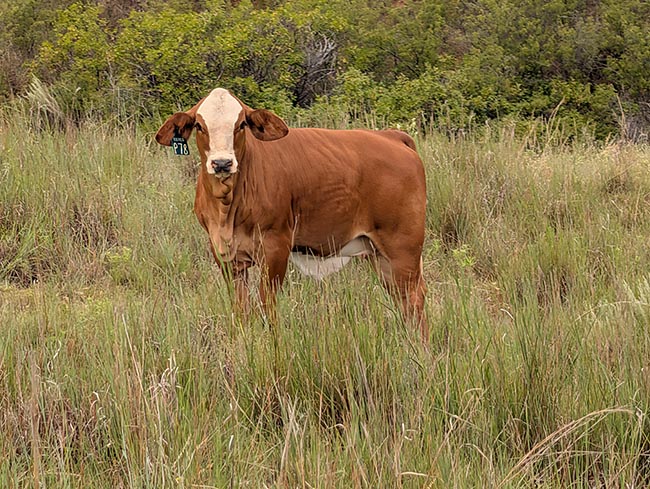
The Estes family markets seedstock by private treaty, and through select sales like the annual Back to Grass Sale.
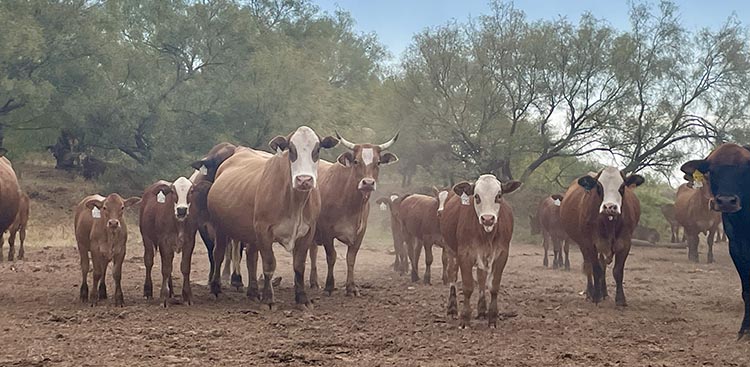
The Simmental-Brahman cross combines the growth, carcass quality, and maternal strengths of the Simmental breed with the adaptability, hardiness, longevity, and heat tolerance of Brahman cattle.
In the feedlot, Simbrah cattle put on muscle and fat differently than the standard Angus feeder calf, which Ben also sees as a positive. The industry-wide push for larger carcasses presents challenges, but Simbrah cattle have the capacity to carry more weight than the standard Angus feeder calf. Additionally, Ben shared that these cattle put on less backfat, which improves cutability.
The hardiness that makes Simbrah cows excel in harsh environments also crosses over to feedlot. “We’ve noted almost zero death loss in our Simbrah cattle due to sickness in the feedlot each year,” Ben said.
Brahman-influenced cattle stand out at the sale barn and in the feedlot, and are sometimes at a disadvantage. Ben shared that the random crossbreeding that many commercial producers in the South rely on has contributed to this negative stereotype. A solution for producers who are hesitant to add any ear to their cattle is to breed these F1 Simbrah females to a purebred Red Angus bull. “We have found that if you run a Red Angus bull back on those cows, it basically takes away the ear, and you still have the added benefit of heterosis,” Ben explained.
Docility is a common concern with Brahman-influenced cattle. Ben believes that this is another stereotype, and one that shouldn’t be an issue if genetics are sourced from a trusted provider. Any animals that display concerning aggression at Estes Ranch are culled. “On the female side, the quickest way to end up in the feedlot is a bad attitude,” Ben said. “With our bulls, we are very strict on that. If a bull has a bad attitude or even looks at me wrong, they will likely become a steer because we just don’t need that,” he added.
Increasing the acceptance of Simbrah cattle throughout the industry is something Ben and his family are passionate about. Collecting data in other herds and proving the breed’s performance in other programs will be an important part of this process. Ben emphasizes that commercial producers don’t need to overthink the process of focusing on a cross like Simbrah. “A lot of people don’t make a decision because it’s overwhelming, and they get caught in the fractions,” Ben shared. “We have been pretty openminded with our Simbrah cattle and how we’ve introduced new genetics. We’re not afraid to breed cattle up, or introduce other breeds.”
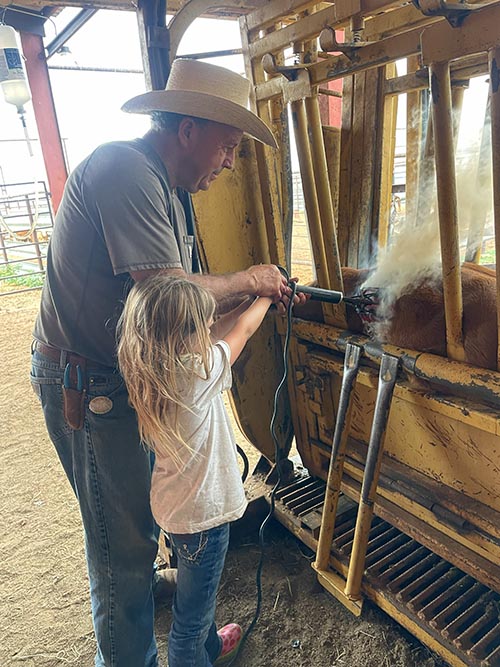
The entire Estes family is involved with the cattle operation.
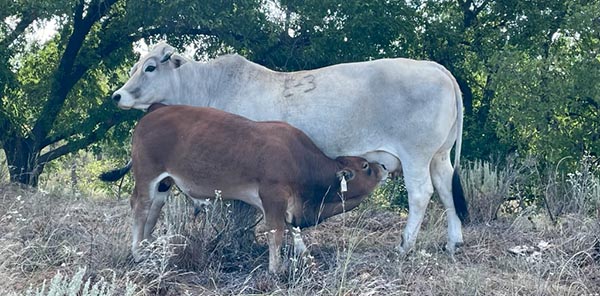
Drought tolerance is extremely important at Estes Ranch.
A Family Affair
In addition to his role at Estes Ranch, Ben works as a large animal veterinarian with a focus on beef cattle. His decision to become a veterinarian was driven by his passion for the beef industry, and a desire to help fellow producers. “I always wanted to work with animals, and especially with cattle,” he shared.
His work reaches beyond helping producers with the general health of their cattle. Ben is frequently asked about mating decisions, how to read EPD, and more, drawing on his knowledge of the seedstock business. Ben’s wife, Sara, is also a veterinarian. Their children, James and Savannah, are actively involved in the ranch, and are members of the American Junior Simmental Association. Ben’s parents, Paul and Amy, and grandparents,Bill and Alcie, are on the ranch. His brother, Will;
sister-in-law, Abbie; their daughter, Emma; sister, Lucy Brown; brother-in-law, Cole; and their children, Brooks, Libby, Whitley, and Tinley, are also actively involved with the ranch. “It’s very tight-knit and family-oriented,” Ben shared.