by Dr. Elizabeth Dressler, ASA Lead Geneticist
The new heifer pregnancy (HP) expected progeny difference (EPD), available for all animals on Herdbook.org beginning the week of May 18, 2026, provides another tool for maternal trait selection.
After extensive development and validation by International Genetic Solutions (IGS), the HP EPD is now available for ASA members. ASA remains committed to developing genetic selection tools for economically relevant traits, and the release of the HP EPD represents another advancement in maternal trait evaluation. For producers retaining replacement females, the HP EPD is a valuable addition to your selection criteria.
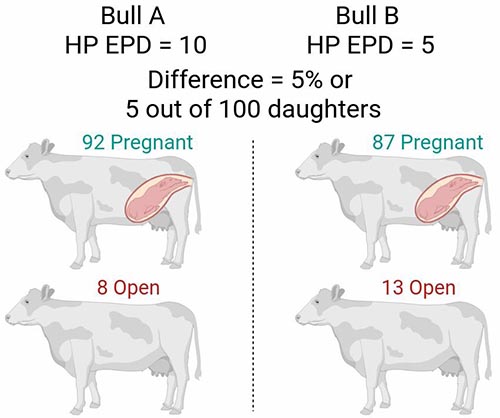
07-11 Figure 1 - Example interpretation of a two-bull HP EPD comparison. (Pregnancy rates of 92% vs 87% were chosen as an example to display a 5% difference. Exact pregnancy rate outcomes will depend on the individual operation.)
There is a myth that selection for low heritability traits, like fertility, results in little genetic progress. However, it is possible to make improvements in traits like HP using genetic selection tools (EPD and indexes) in combination with sound management. Using an EPD for selection on female reproductive traits is especially important for several reasons: 1) the trait is observed later in life, 2) the trait is sex-limited (not directly observed in males), and 3) the trait has low heritability. For low heritability traits, most of the observable phenotypic differences are due to environment rather than genetics. That means selecting for HP by phenotype alone, instead of an EPD or index, would make genetic progress much slower and less accurate.
Phenotypic Data Reporting for HP
The Total Herd Enrollment (THE) program plays a critical role in collecting the phenotypic data needed to develop and maintain genetic evaluations for maternal traits, including HP. THE is a comprehensive dam inventory program designed to facilitate complete data reporting across contemporary groups. Dam enrollment, calving, and productivity information reported through THE is used to generate the HP phenotypic dataset. A heifer’s phenotype is categorized as either a success or failure of becoming pregnant over an entire 90-day breeding season. Proper dam enrollment, along with correct use of productivity and removal codes, is essential for maintaining accurate phenotypic records.
Genetic trend in HP
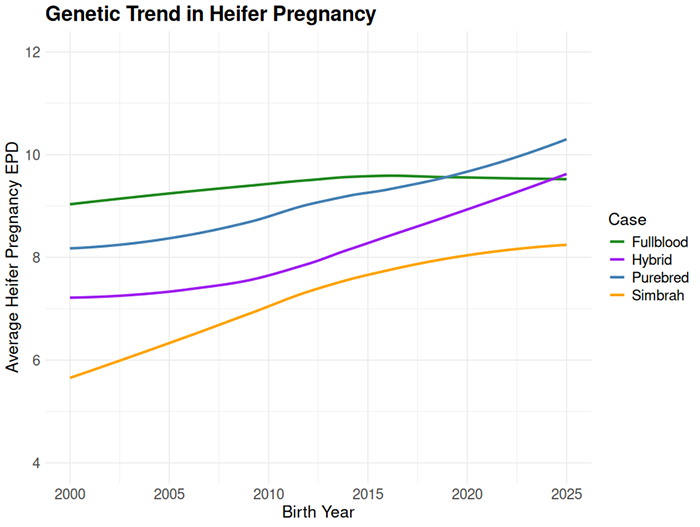
The Simmental population has made genetic improvement in HP over time. Since 2000, the average HP EPD of purebred animals has increased from 8.1 to 10.3 (Figure 2). Although the stand-alone EPD for HP is new, genetic progress in HP has still occurred over the past few decades. As ASA’s All Purpose Index ($API) indirectly incorporates HP (through weightings with correlated traits), selection for improved $API would also drive indirect genetic improvement in HP. Now that a stand-alone HP EPD is available, producers can make more targeted selection for this trait.
Using Percentile Rankings to Compare HP EPD
It can take some time to wrap our minds around a new EPD. Is my animal’s HP EPD good or bad? How does it compare to other sire options? A simple way to answer some of these questions is to look at percentile rankings. On an animal’s Herdbook page, there is a row for percentile rankings (%) under the EPD. There is also a percentile ranking table for all EPD available on Herdbook. This number will range from 1 to 99. For HP, larger values are more favorable and will rank closer to 1%, whereas lower numbers are unfavorable and will rank closer to 99%. Figure 3 shows the distribution of HP EPD for purebred bulls born within the last five years with lines for the 5, 10, and 25 percentiles. To make genetic progress for HP, select sires that fall on the right side of Figure 3, or have rankings in the top percentage of the population.
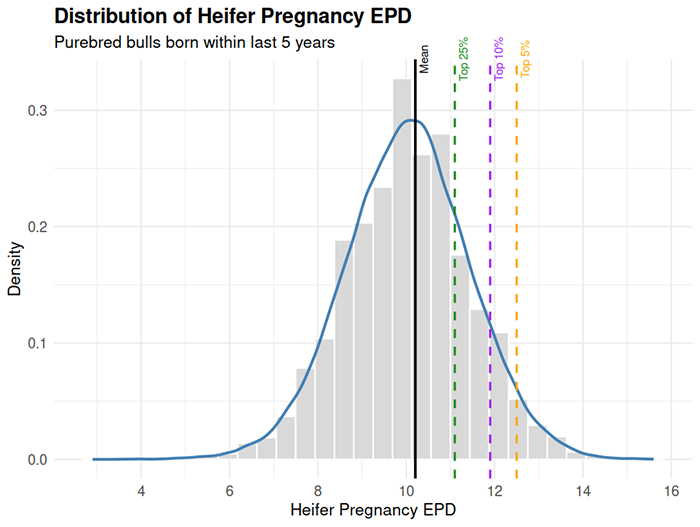
07-13 Figure 3 - Distribution of the HP EPD for purebred bulls born within the last five years. Lines for the 5, 10, and 25 percentiles are overlaid on the graph.
Key Takeaways
● The HP EPD available on Herdbook beginning the week of May 18, 2026, gives ASA members a new tool for maternal trait selection.
● The HP EPD predicts differences in the percentage of daughters that will conceive and calve at two years of age, with higher values being favorable.
● Lowly heritable traits, like HP, are heavily influenced by the environment, making phenotype alone a poor indicator of genetic merit; using EPD and indexes leads to faster and more effective genetic progress.
● Genetic trends show steady improvement in HP over time in the Simmental population, and producers can now use the HP EPD and percentile rankings to make more targeted selection decisions.