Challenges to Beef Packing Infrastructure
by Derrell S. Peel, Oklahoma State University Extension
Recent announcements of facility closures from the beef packing industry highlight the continuing challenges that low cattle inventories pose for the beef industry. Beef packing represents large investments in facilities and a long-term perspective. Adjustments in packing capacity occur slowly and are not just the result of current cattle inventories but the cumulative impacts over time. Figure 1 shows how average cattle inventories have decreased over time.
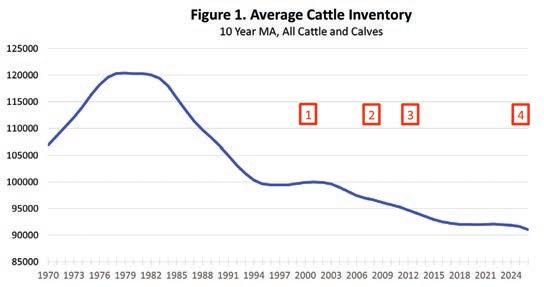
The majority of beef packing capacity was built from the 1960s into the 1980s, when average cattle inventories were 20–30 million head larger than today. Adjustments to packing infrastructure occur slowly and abruptly with different regional impacts. The numbered boxes in Figure 1 correspond to the major adjustments to fed packing capacity in the past 26 years.
1. ConAgra plant burned, 2000, Garden City, Kansas (unplanned reduction; plant not rebuilt)
2. Tyson plant closed, 2008, Emporia, Kansas
3. Cargill plant closed, 2013, Plainview, Texas
4. Tyson plant closed/Amarillo plant reduced, 2026, Lexington, Nebraska/Amarillo, Texas
With both plant numbers and capacities fixed in the short run, Saturday slaughter is the principal source of flexibility for the packing industry to adjust to short-run changes in cattle numbers. Figure 2 shows Saturday slaughter as a percentage of total slaughter for the past 30 years (red symbols correspond to plant closures). When cattle numbers are insufficient, the Saturday slaughter percentage decreases. The previous cyclical low in cattle inventories prompted generally low Saturday slaughter rates from 2009–2015. The one-year bump in 2013 was likely the result of the plant closure that year.
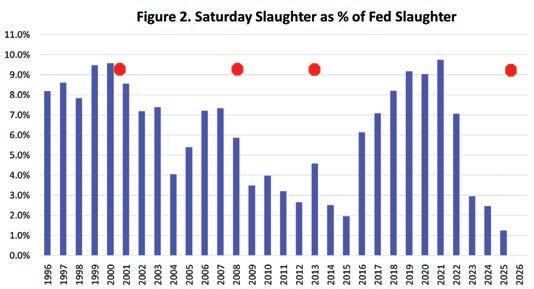
Low Saturday slaughter rates since 2023 show the impact of current low cattle inventories on the packing sector. The 2025 Saturday slaughter rate of 1.2% is the lowest in the past 30 years. The recent plant closure and reduction by Tyson will provide some relief in 2026. With cattle inventories unlikely to grow much, if any, in the next couple of years, it is not clear whether additional packing sector adjustments will be needed.
GLP-1 Use Reshapes Conversations around Beef and Nutrition
As people’s use of GLP-1 weight-loss medications continues to rise, K-State experts say the conversation around nutrition, protein intake, and beef’s role in a healthy diet is evolving for both consumers and the cattle industry.
In a recent Cattle Chat podcast from the Kansas State University Beef Cattle Institute, specialists discussed how these medications — designed to reduce appetite and promote weight loss — are changing how and what people eat. “While overall calorie intake may decrease, maintaining proper nutrition remains a top priority,” said Abby Heidari, a registered dietitian with the Kansas Beef Council.
Experts emphasized that beef continues to offer important nutritional value, particularly as a high-quality protein source that supports muscle maintenance during weight loss. “As people eat less, every bite matters more,” Heidari said. “Foods (like beef) that deliver essential nutrients — like protein, iron, and vitamins — become even more important.”
For consumers using GLP-1 medications, this shift means focusing on nutrient-dense foods in smaller portions. Balanced diets that include appropriate servings of beef can help meet protein needs while aligning with updated dietary recommendations.
Experts noted that beef producers may benefit from understanding these shifting preferences and communicating beef’s nutritional advantages more effectively. Transparency, education, and alignment with consumer health goals will be key in maintaining trust and demand, they said.
The discussion also highlighted that dietary guidelines continue to support flexibility, allowing beef to be part of a healthy eating pattern when consumed in moderation and alongside other nutrient-rich foods.
Ultimately, specialists say the intersection of GLP-1 medications and dietary guidance underscores a broader trend: Consumers are becoming more intentional about their food choices. “Whether someone is using these medications or not, the focus is shifting toward nutrient density and overall diet quality,” Heidari said. “That’s an important message for both consumers and the beef industry moving forward.”
Add Value, Manage Market Volatility by Selling Beef Directly to Consumers
Despite cattle prices being near all-time highs, marketing beef direct-to-consumer still adds value to beef operations. Two updated University of Missouri (MU) Extension guides help producers understand the numbers and methods behind marketing your beef to consumers.
“Low cattle inventory has widened the gap between a finished animal’s live value and the total value of its retail cuts,” said Jake Hefley, MU Extension agriculture business specialist in Taney County. “Direct marketing gives producers an opportunity to capture part of that value rather than leaving it entirely to downstream segments of the supply chain.”
Producers can examine the revenue potential and additional costs of selling freezer beef with “Evaluating Direct-to-Consumer Marketing Opportunities for Local Beef in Missouri” and look at their cost of production to feed out their calves with “On-Farm Beef Finishing Planning Budget.” Both publications are available for free download at https://extension.missouri.edu/publications.
“Using both publications together helps producers compare the retail value of a processed animal with the cost to bring that animal to finished weight,” said Drew Kientzy, MU Extension senior research analyst. “Grocery store beef prices are front-of-mind for many consumers. Knowing your breakeven and offering competitive pricing for a high-quality product can earn long-term customers.”
Producers are encouraged to use the accompanying spreadsheet tools to help estimate the cost and revenue potential of their own direct-to-consumer beef sales.
Direct sales can provide price stability
Strong markets draw attention, but producers know conditions can change quickly. When prices are high, it can be tempting to market everything through the sale barn, yet freezer beef doesn’t have to be an all-or-nothing decision, said Jennifer Lutes, MU Extension agricultural business field specialist in McDonald County. Many farms can operate in both markets by selling more calves into today’s strong auction market while finishing a smaller number for direct customers (or at minimum not expanding direct-market commitments). The key is protecting your freezer-beef customer base now, Lutes said. Those relationships take time to build and will be the stabilizing income stream you’ll want in place when prices eventually ease.
“Consumers value quality and relationships, making the prices they are willing to pay less volatile than prices received at the local sale barn,” she said. “An established freezer beef business can help customers manage costs during high grocery prices and support farm income when cattle prices drop.”
How is Artificial Intelligence Enhancing Cattle Health Monitoring?
by Maddy Krueger, Bovine Veterinarian
Artificial intelligence (AI) has made its way into agriculture in various ways, providing new technologies to enhance production agriculture. At the University of Arkansas, researchers developed a tool, the CattleFever system, that uses AI and thermal and RGB color cameras to detect cattle body temperature.
Traditionally, cattle temperatures are taken rectally. With the CattleFever system, this can reduce labor required to track herd health. Temperature is a key symptom for many diseases, so this system allows for faster detection and treatment.
Research Background
The University of Arkansas is equipped with an Artificial Intelligence and Computer Vision Lab, directed by Ngan Le, associate professor in the Department of Electrical Engineering and Computer Science. She explains one of her key research
directions is precision agriculture with artificial intelligence and computer vision.
Previous projects have focused on poultry, but broader agriculture-related projects, including cattle welfare, are on the horizon. Le says, “This motivation led me to initiate collaborations with colleagues in the Department of Animal Science, including Dr. Kegley, Dr. Powell, and Dr. Zhao, to combine their expertise in cattle with our strengths in AI and computer vision.”
This project initiative was closely supported and funded by the University of Arkansas Division of Agriculture.
Platform Construction
To build CattleFever, researchers needed data. However, the existing data for cattle only provided overhead rather than thermal images. So, the group built their own dataset using thermal images of calves. Collaborating with the Savoy Research Complex at the university, calves were recorded with synchronized RGB cameras, technology that captures images with red, green, and blue light, and thermal cameras.
Rectal temperatures were also recorded for a base in the dataset. Technical team members, Trong Thang Pham and Ethan Coffman, along with several undergraduate students, developed a semi-automated annotation and data processing system. More than 600 recorded frames were used to train the system in what to look for. This data all served as a benchmark for the CattleFever system.
All images gathered were linked to thermal and RGB images. Landmarks in 13 different places, such as eyes, ears, muzzle, and mouth, on the animal were established. “These landmarks allow the system to localize individual facial regions, and the thermal camera then measures the temperatures in those regions,” Le says.
The eyes and nostrils read closest to the rectal temperatures, so these landmarks were established as focus areas for thermal image readings. A machine-learning approach was used to predict data results. These technology trainings resulted in CattleFever being able to automatically detect animal temperature within one degree of the rectal reading. Le explains that as more data is collected in real-life environments, the more accurate the system will become.
Project Outlook
In these studies, all cattle were directly facing the thermal cameras. “We probably need to take more photos of them in the real-world settings, such as running around, to capture their motion in the field,” Pham explains.
Teaching the cameras how to recognize and interpret a cow’s face in real-world environments is the next step. Le explains further features like environmental and audio sensors will be added to increase animal welfare monitoring accuracy and lead to more developments of indicators like common symptoms or early signs of illness. At this point, additional funding is being sought to continue more research on this project.
Eventually, the goal is for producers to have access to technology like this. This could look like a monitoring system of cameras that are synced to a mobile interface or app.
Le says, “While the current work represents an important first step, we are excited about continuing to develop technologies and expanding its capabilities to support the real-world agricultural applications.” .