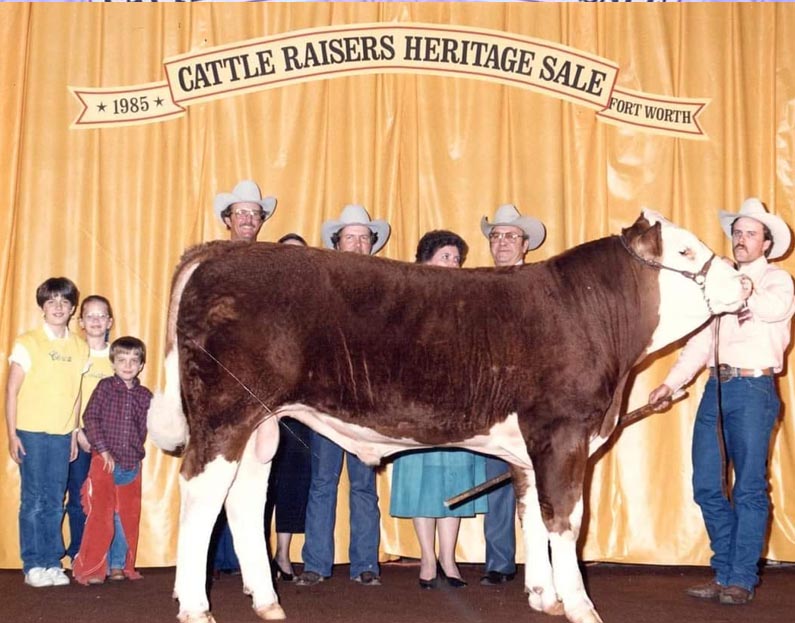
John B. Collier, Stephenville, Texas
Gibbs Farms, Ranburne, Alabama
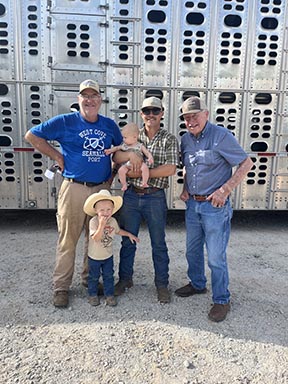
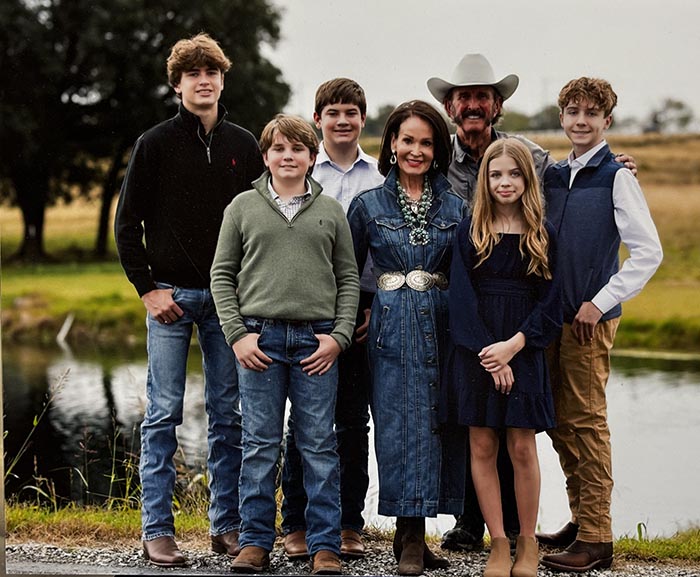
Wendell (R) with his son, Doug (L); grandson, Bradley (middle); and great-grandsons, Swayze and Sadler.
The Gibbs family has been raising SimGenetics cattle since 1972, when they transitioned their herd from polled Herefords. As the industry shifted toward black-hided cattle, Gibbs Farms was at the forefront, adding Angus to their program before SimAngus became an industryleading cross.
Wendell grew up on a farm that raised cotton, and his father owned a feed mill and raised poultry. This instilled a lifelong interest in agriculture, which he has passed on to generations. Gibbs Farms started with a small plot of land, which has grown into a significant operation, raising seedstock and farming both crops and timber. Wendell worked as a bank executive before going full-time for the operation in 1988 following retirement. Alongside his wife, Nan, Wendell and his family have continually improved and grown their cow herd.
After first experimenting with breeding Angus cows to Simmental, Wendell planned to market these crossbred cattle as commercial feeder calves. Seeing the growth and other positive traits of this cross, he quickly realized an opportunity to do something entirely new. They started selling SimAngus seedstock, marketing the maternal strength of the females and the wide array of benefits commercial producers could get from hybrid vigor. After seeing success with SimAngus females, their customers started asking for crossbred bulls as well. This kickstarted what is now a decades-long focus on raising sought-afterSimAngus genetics.
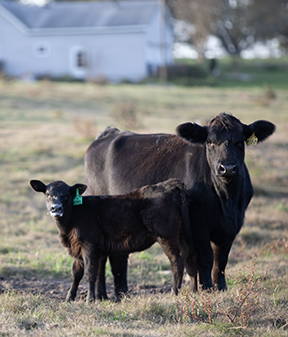
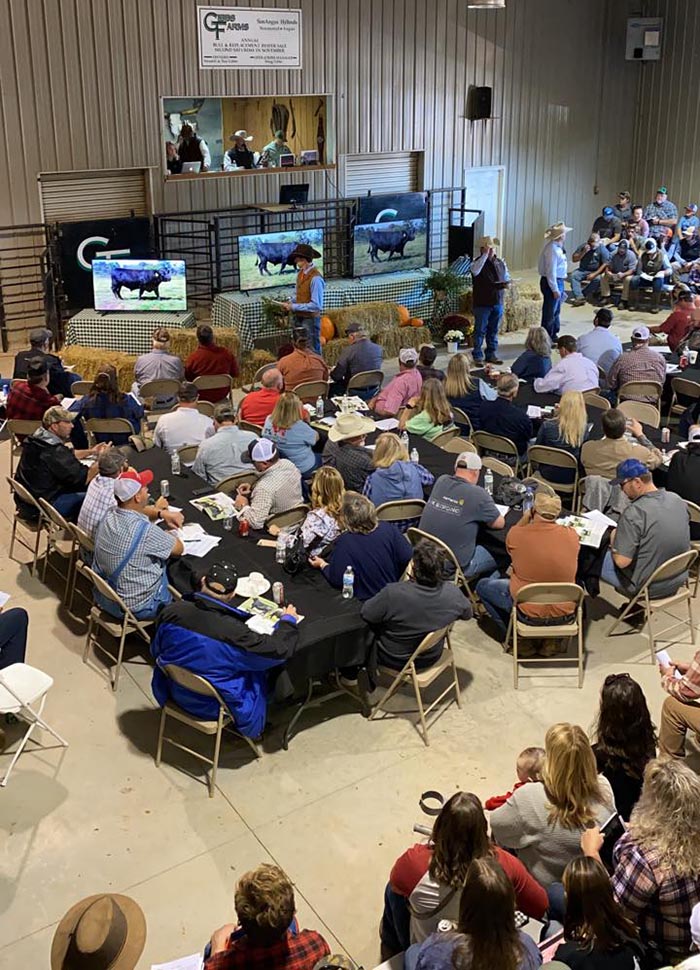
Above: The Gibbs family started breeding their Angus cows to Simmental
bulls years before the term SimAngus was coined. Right: Producers travel
from throughout the country to attend the annual Gibbs Farms sale.
In 2005, Gibbs Farms decided to accelerate their already successful SimAngus seedstock business by purchasing the entire Simmental and Angus herd from Optimal Beef Genetics, Bell Farms, and Pineview Farms. This expansion allowed the Gibbs family to meet the demand for their SimAngus bulls.
Today, Gibbs Farms continues this commitment. Wendell and Nan’s son, Doug, and grandson, Bradley, lead the operation. Data collection — from carcass records to cow herd records — are meticulously kept and submitted to the Association. The family has been recognized as a Performance Advocate by ASA many times, and have participated in a range of whole-herd data collection programs. The Gibbs prefix appears in influential pedigrees throughout the breed, and their annual sale draws in seedstock and commercial producers from across the country. AI and ET technology are utilized throughout the operation.
Each generation of the Gibbs family has held leadership positions in the industry, including through the Alabama Cattleman’s Association, Alabama Beef Cattle Improvement Association, and both the Alabama and Georgia Simmental Associations. Beyond being stewards of their cow herd, the Gibbs family prioritizes the health of their land — rotational grazing, riparian area fencing, and more are utilized.
Doug and his wife, Lucretia, have three children: Whitney, Toni, and Bradley. Wendell and Nan’s daughter, Lorie, and her husband, Chad, have four children: Trey, Nancy, Grace, and Ella. Wendell and Nan’s daughter, Wendy, and her husband, Chad, have three children: Clayton, Samuel, and Madison.
Golden Book Award Recipients 1982 to Present
Jerry Moore, ’82, Canton, OH
Dr. Horst Leipold, ’82, Manhattan, KS
Dr. Harry Furgeson, ’82, Anaconda, MT
Don Vaniman, ’85, Bozeman, MT
Dr. Ray Woodward, ’86, Miles City, MT
Lou Chesnut, ’86, Spokane, WA
Jess Kilgore, ’87, Three Forks, MT
Arnold Brothers, ’87, McIntosh, SD
Rob Brown, ’88, Throckmorton, TX
Bob Dickinson, ’88, Gorham, KS
Tom Abell, ’89, Wharton, TX
Ron Baker, ’89, Hermiston, OR
Albert West, III, ’90, San Antonio, TX
Miles Davies, ’92, Deer Trail, CO
Henry Fields, ’92, Claude, TX
Dr. Earl Peterson, ’92, Littleton, CO
Colville Jackson, ’92, Gloster, MS
Ancel Armstrong, ’93, Manhattan, KS
Javier Villarreal, ’94, Acuna Coah, Mexico
Dr. Harlan Ritchie, ’94, East Lansing, MI
Bud Wentz, ’94, Olmito, TX
Kay Thayer, ’95, Bozeman, MT
Walt Browarny, ’95, Calgary, AB
Steve McGuire, ’96, Bozeman, MT
H.W. Fausset, ’96, Worland, WY
Hugh Karsteter, ’97, Cushing, OK
Nina Lundgren, ’97, Eltopia, WA
Don Burnham, ’99, Helena, MT
Dr. Bob Schalles, ’99, Manhattan, KS
Tom Risinger, ’99, Crockett, TX
Bill Spiry, ’00, Britton, SD
Bob Christensen, ’00, Malvern, IA
Kay Klompien, ’01, Bozeman, MT
Robert Haralson, ’01, Adkins, AR
Dr. John Pollak, ’02, Ithaca, NY
Dr. Dick Quaas, ’02, Ithaca, NY
Dr. Jerry Lipsey, ’03, Bozeman, MT
Marty Ropp, ’03, Bozeman, MT
Jim Taylor, ’03, Wallace, KS
Dr. Joe & Mary Prud’homme, ’04, Tyler, TX
Dr. Bob Walton, ’05, DeForest, WI
Sam Smith, ’05, Prague, OK
Emmons Ranch, ’05, Olive, MT
Hudson Pines Farms, ’06, Sleepy Hollow, NY
Dan Rieder, ’06, Bozeman, MT
Silver Towne Farms, ’07, Winchester, IN
Gateway Simmental, ’07, Lewistown, MT
Dr. Larry Cundiff, ’07, Clay Center, NE
Reese Richman, ’08, Tooele, UT
Clifford “Bud” Sloan, ’08, Hamilton, MO
Sally Buxkemper, ’09, Ballinger, TX
Nichols Farms, ’09, Bridgewater, IA
Triple C Farms, ’09, Maple Plain, MN
Linda Kesler, ’10, Bozeman, MT
Stuart Land & Cattle, ’10, Rosedale, VA
Powder Creek Simmentals, ’10, Molena, GA
Tom Clark, ’11, Wytheville, VA
Harrell Watts, ’11, Sardis, AL
Frank Bell, ’12, Burlington, NC
John Christensen, ’12, Wessington, SD
Bob Finch, ’12, Ames, IA
Willie Altenburg, ’13, Fort Collins, CO
Tommy Brown, ’13, Clanton, AL
Roger Kenner, ’13, Leeds, ND
Dr. Michael Dikeman, ’14, Manhattan, KS
Val & Lori Eberspacher, ’14, Marshall, MN
Hounshell Farms, ’14, Wytheville, VA
Verlouis Forster, ’15, Smithfield, NE
Jennie Rucker, ’15, Hamptonville, NC
Dr. Mike Tess, ’15, Bozeman, MT
Bill Couch, ’16, Owensville, IN
Billy Moss, ’16, McCormick, SC
Pine Ridge Ranch, ’17, Dallas & Athens, TX
Dr. Calvin Drake, ’17, Manhattan, KS
Jim Berry, ’17, Scales Mound, IL
Reflected R Ranch, ’18, Sugar City, CO
Swain Select Simmental, ’18, Louisville, KY
J.W. Brune, ’19, Overbrook, KS
Doug Parke, ’20, Paris, KY
Bob Volk, ’20, Arlington, NE
Gordon Hodges, ’21, Hamptonville, NC
Steve Reimer, ’21, Chamberlain, SD
Fred Schuetze, ’21, Granbury, TX
Tom Hook, ’21, Tracy, MN
Kevin Thompson , ’21, Almont, ND
Parke & Nina Vehslage, ’21, Brownstown, IN
Scott Riddle, ’22, Hubbard, TX
Wade Shafer, PhD, ’22, Bozeman, MT
Gib Yardley, ’22, Beaver, UT
Hart Simmentals, ’23, Frederick, SD
Neil Martin, ’23, Lyles, TN
Cynthia Conner, ’23, Bozeman, MT
Jim Largess, ’23, Bozeman, MT
Cow Camp Ranch, ’24, Lost Springs, KS
Dr. Henry Allen, ’24, Versailles, KY
Erroll and Gayle Cook, ’25, Walsh, CO
Darrell Stiles, ’25, Cushing, OK